Deep Dive Oct 15, 2026
AI agents do their hands-on work on CPUs: four chipmakers brought dedicated racks, and buyers so far are buying CPU capacity
Published October 15, 2026; rewritten October 23 to a higher writing standard. Nothing that happened after publication was added.
Key takeaways
An AI agent is AI that takes a task and carries it out: the model works out the next step on GPUs, and the tools and programs the agent calls run on CPUs. GPUs and CPUs are two kinds of computer chip. At the annual hardware summit of the Open Compute Project (OCP) on October 12, AMD, NVIDIA, Intel and Arm all brought CPU racks built for running agents' tools, meaning whole cabinets of ready-made CPU servers. As of October 15, 2026, buyers already buy the CPUs that agents need separately from GPUs. The largest case is Meta buying CPU cores in Amazon's cloud, AWS. In the press releases, filings, papers and analyst reports this piece checked, no buyer has yet said in public that it bought a whole rack designed for agents. On this publication's read, near-term business in the CPUs that agents use goes to whoever can deliver. The only support is one company: Intel's filing reports demand outrunning its supply.
One: The division of labor: an AI agent thinks on GPUs and does the work on CPUs
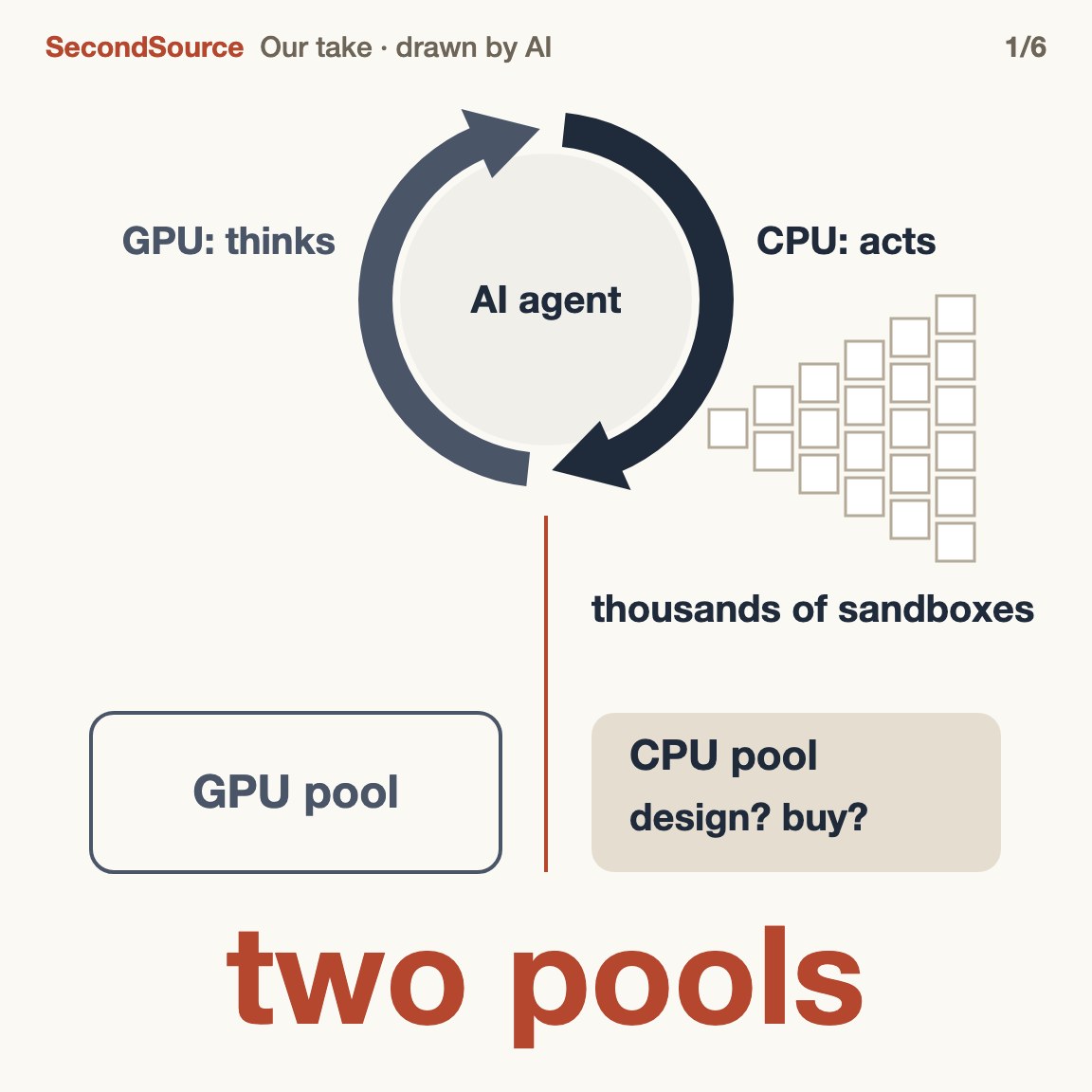
An AI agent does more than answer questions. It carries out tasks, such as searching the web, writing a piece of code and running it, or operating a piece of software. It works in a loop: the model decides what to do next, calls a tool to do it, gets the result back, then decides the next step, until the task is done.
The two halves of that loop run on different chips. Deciding the next step is the model computing, which the industry calls inference. GPUs are good at doing huge numbers of identical calculations at once, which is what a model needs; they are not built to run ordinary software. The hands-on half is searching, reading and writing files, and running code. That is ordinary software, written to run on CPUs. Code an agent writes usually runs in a sandbox: a walled-off small computing environment, so a program that goes wrong cannot touch anything outside. Each task gets a sandbox, so with many tasks, sandboxes open by the thousands, and every one needs CPU.
Chipmakers are building products around exactly this split. NVIDIA says its Vera CPU rack "is designed to support tool calling, orchestration and sandboxed execution". Orchestration means deciding which tool runs first and where results go. Training and inference for the model go to a separate GPU rack. AMD's Helion rack also comes in a CPU-only configuration, which AMD says provides "dedicated capacity for agent execution" and connects to separate model inference equipment.
This piece treats GPUs and CPUs as two pools; agents use the CPU pool, which raises two choices. The first is design. A core is the unit inside a CPU that actually executes instructions, and one server CPU has dozens to more than a hundred. One path is density: the more cores and memory packed into a rack, the more sandboxes can run at once. The other path is single-core speed: an agent works one step after another, and each step waits for the result of the one before, so the steps of a single task cannot run at the same time however many cores there are; how long one task takes from start to finish depends on how fast a single core is. The second choice is how to buy: buy CPU capacity, meaning cores and power, whether rented from a cloud or built in-house and in no particular rack format; or buy, by name, a whole rack designed for agents.
This piece answers in order: who sells this pool of CPUs (section two), who is already buying and whether they buy capacity or whole racks (section three), what each design path covers (section four), and who is likely to win the business in the near term (section five).
Two: Four chipmakers brought CPU racks for agents, and the line started in March
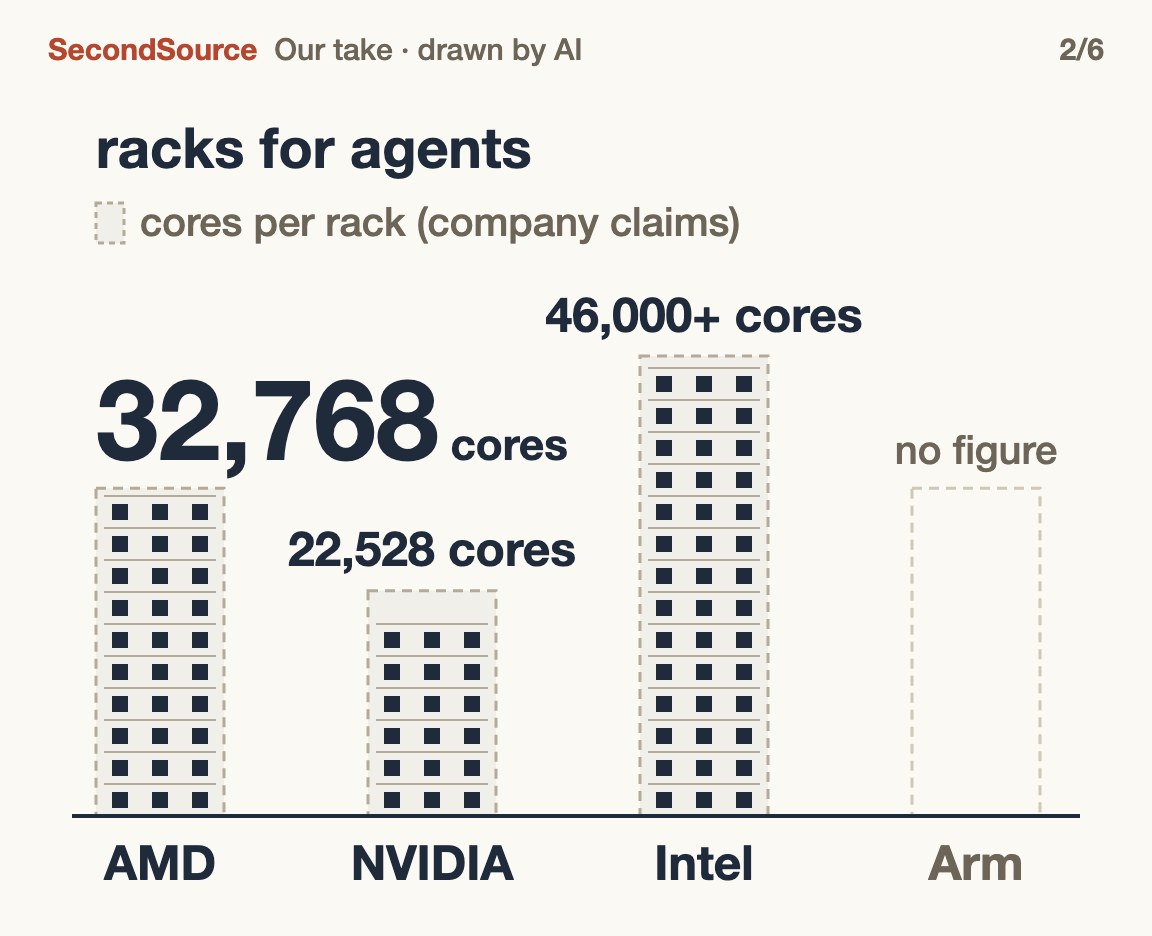
This publication's October 13 issue recorded only two of them, AMD and NVIDIA. Intel and Arm were at the same summit too:
| Vendor | Product | Scale (vendor's figures) | Timing |
|---|---|---|---|
| AMD | CPU-only configuration of the Helion rack | Up to 32,768 cores per rack | Available November 2026 |
| NVIDIA | Vera CPU rack | Up to 256 CPUs and 22,528 cores per rack | First systems delivered |
| Intel | Rack design built on Xeon 6+ processors | Some configurations above 46,000 cores per rack | Shown at the summit |
| Arm | AGI CPU systems | 136 cores per chip (the sources checked give no per-rack core count) | Systems on sale |
Arm's systems are sold by system builders such as Supermicro and Verda; a system builder is a company that assembles chips into complete servers for sale.
The line did not start in October either. Arm announced its CPU product, the AGI CPU, on March 24, with Meta as co-development partner. NVIDIA unveiled the Vera CPU on May 31. On September 30 CoreWeave, which rents out computing racks, announced Vera racks for rent.
Three: Buyers already buy this pool of CPUs separately; they buy capacity, and no whole rack built for agents has a public buyer
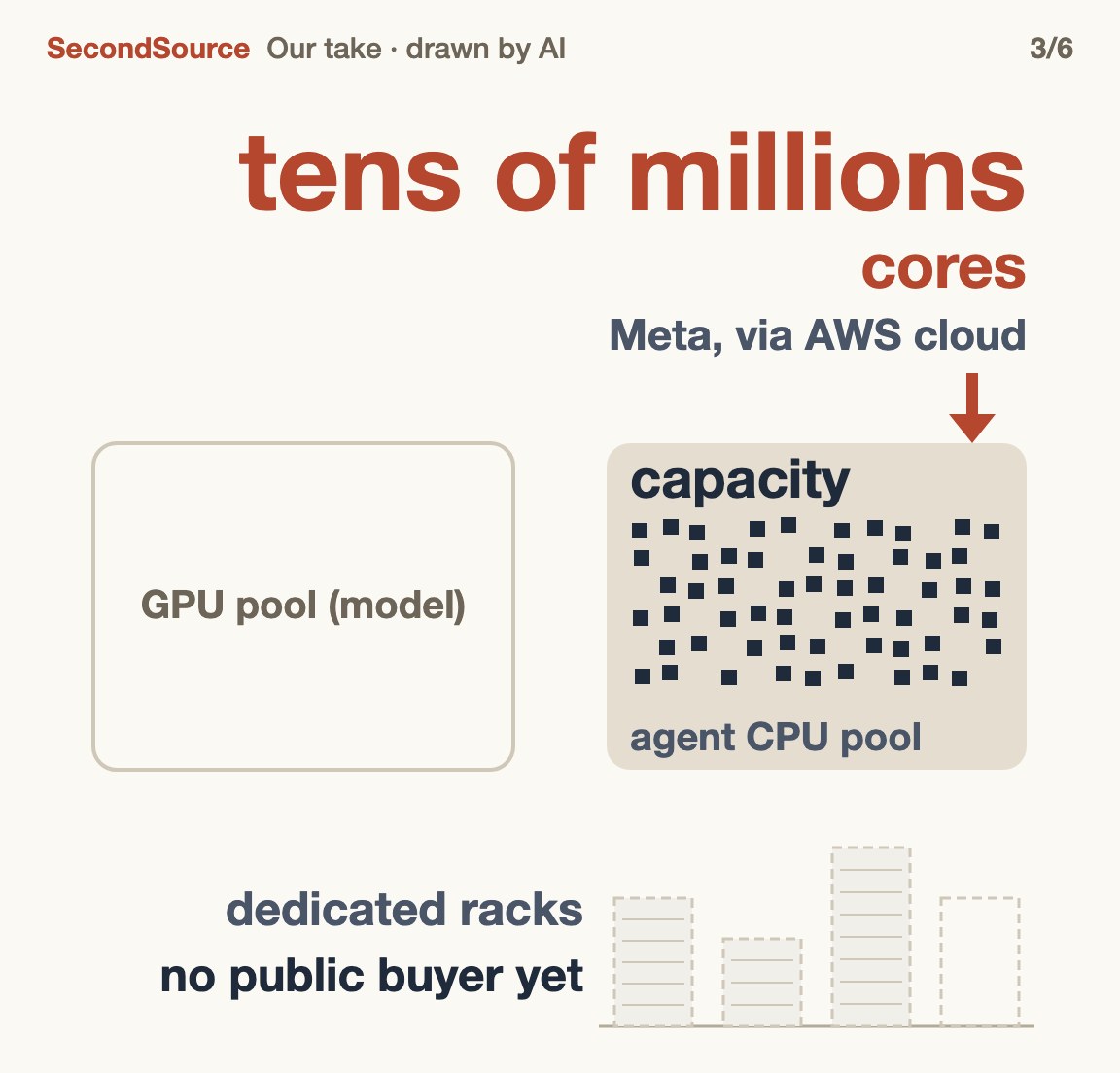
The largest public purchase is Meta's. At the end of April Meta and AWS announced a multi-year, multibillion-dollar deal under which Meta deploys "tens of millions of Graviton5 processor cores." Meta's head of infrastructure said the deal is to run "the CPU-intensive workloads behind agentic AI," meaning the CPU-hungry work behind agents. Graviton5 is a CPU that AWS designs and offers in AWS's cloud, so this deal buys capacity. The form of the contract has not been published.
The second case is not built for agents, but it shows CPUs already being planned on their own. At Microsoft's data-center campus called Fairwater, according to an on-site report in February by SemiAnalysis, a firm that researches the AI and semiconductor supply chain, a 48 MW CPU and storage building supports a 295 MW GPU cluster. MW measures how much electric power a facility can draw. The same report says AI labs doing reinforcement-learning training are short of CPUs and are competing with cloud providers for the same ordinary x86 servers. Reinforcement learning trains a model by having it do tasks over and over and rewarding it when it gets them right; training agents this way needs large numbers of sandboxes.
The rest are early signs: some are already in use, but none yet counts as the "public buyer" in this section's heading. This piece counts only a buyer stating in public that it bought a whole rack dedicated to agents; a seller saying it delivered, or a cloud company renting racks out, does not count. NVIDIA says its first Vera CPU systems went to AI companies including Anthropic and OpenAI, with no quantities published; that is NVIDIA's statement on its product page, and this piece found no company on the list stating what it bought. Perplexity, which builds agent products, said in early October that it had started moving its sandboxes onto Vera, without saying whether it bought whole racks or rents them. CoreWeave, from section two, is a cloud company that rents out Vera racks, and the material this piece found does not say to whom.
Four: Density or single-core speed: this publication reads each path as covering a different stretch
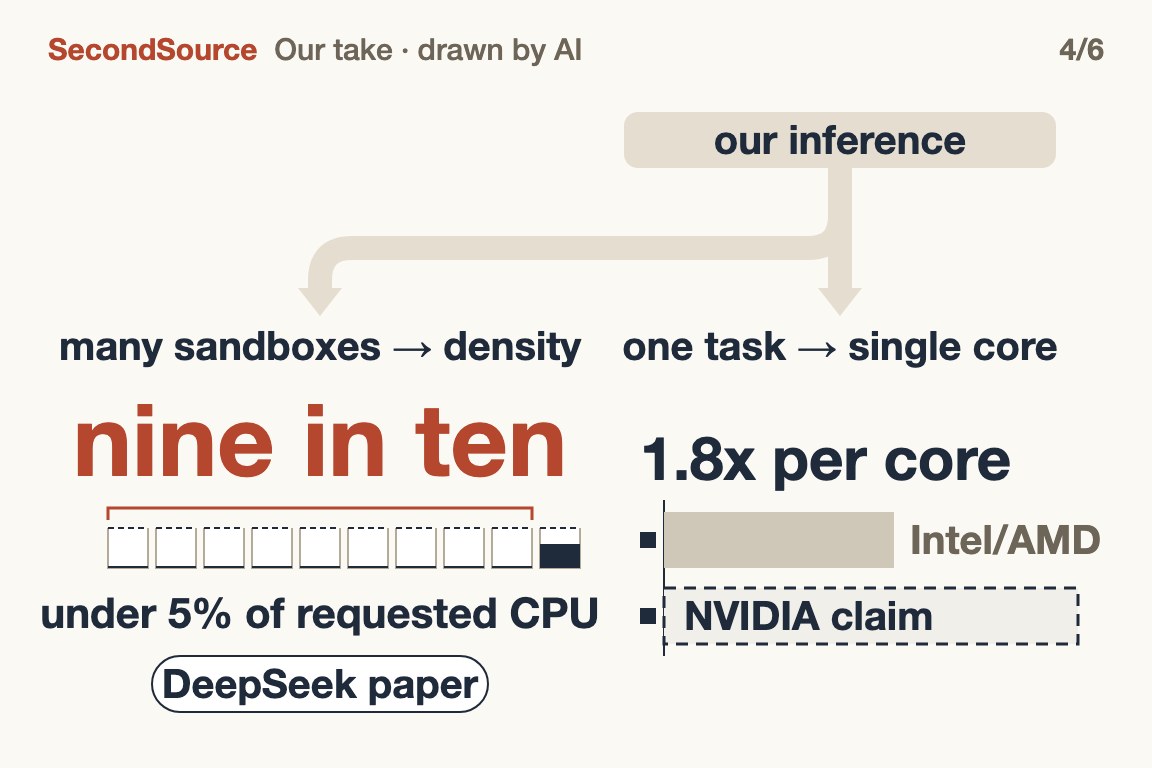
Each path from section one has a vendor betting on it. AMD's Helion sells density. NVIDIA's CEO argues that agents need the CPU with the fastest single core, and that cloud CPUs designed to rent out more cores point the wrong way.
For the stretch of running large numbers of sandboxes at once, there is one public operating reading. In September the AI company DeepSeek published a paper describing DSec, the sandbox system it uses to train agents: about 160 CPU servers and 30,000 cores, running about three million sandboxes a day. About nine in ten sandboxes use, on average, less than 5 percent of the CPU allowance they requested before starting. Most sandboxes leave their CPU nearly idle. This publication's inference: this kind of load needs a rack that holds more sandboxes, which is density. The limits: this is one company's training fleet, and no one has published sandbox usage for agent products serving live users. The 5 percent is measured against what was requested, so over-requesting would also push it down.
For the stretch where a single task needs to be fast, NVIDIA reports that Vera delivers 1.8 times the per-core performance of x86 CPUs; x86 is the mainstream design of Intel's and AMD's server CPUs. Perplexity's own test measured whole workflows, which ran about 1.5 times faster. Both are numbers reported by vendors and their partners, and they measure different things, so they cannot confirm each other; neither names the CPU it compared against.
The evidence on the two stretches differs in weight. Even NVIDIA, which leads with single-core speed, publishes density as its main rack-level specs: chip count, core count and 400 TB of memory per rack. Brendan Burke, an analyst at Futurum, a research and advisory firm for technology companies, judges that the two designs "are more likely to prove complementary than substitutable." Public data also shows no buyer choosing one over the other. This publication holds that reading with low confidence until an independent test on the same workload appears (reading 3 in section six).
Five: Near-term business in this pool goes to whoever can deliver
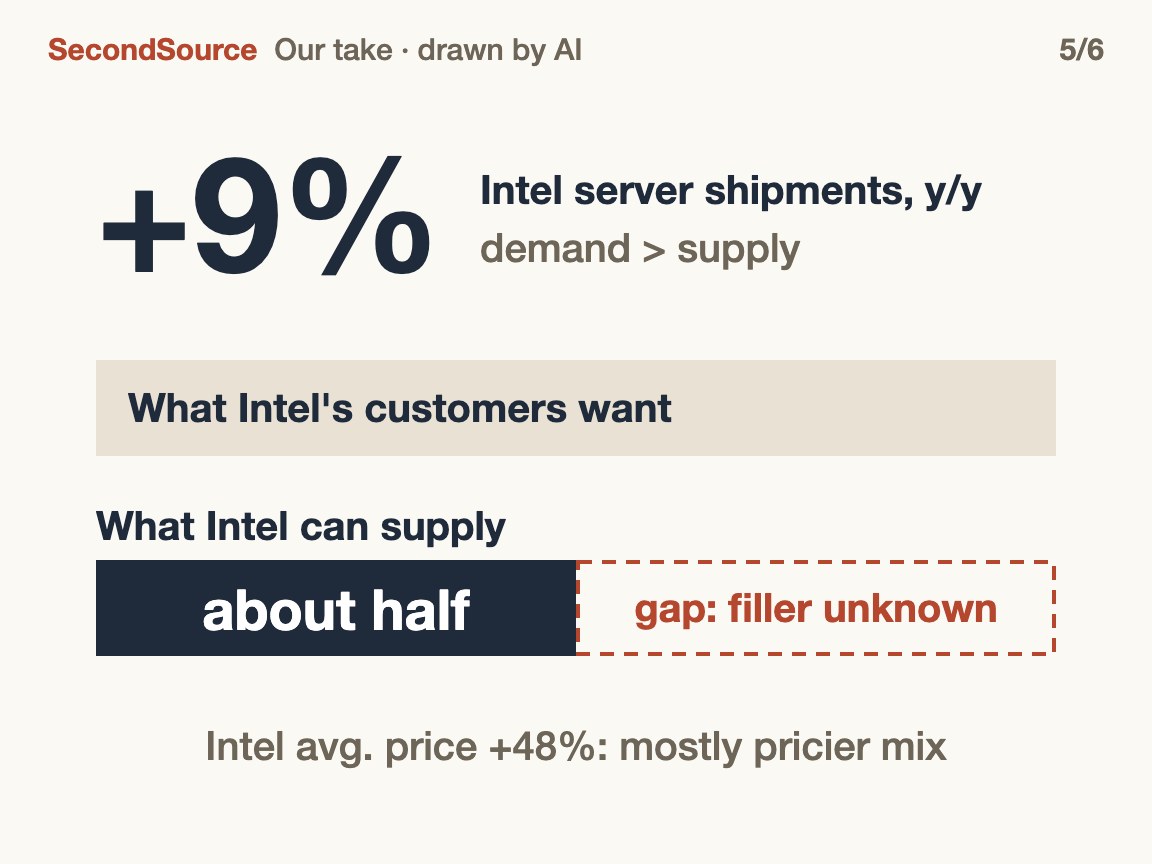
Near-term here means the second half of 2026 through the first half of 2027.
Intel's filing for the second quarter of 2026 says two things at once: server unit volume rose 9 percent on a year earlier, mainly on demand from large cloud providers; and "market demand exceeded our available product supply," because of internal supply constraints. Intel's CEO said in September, according to SiliconANGLE, that Intel can meet only about half of customer CPU demand.
In the same filing, Intel's average server selling price rose 48 percent. This publication does not use that figure as evidence of a shortage: the filing states that most of it came from selling more premium products, with demand-based price changes contributing less.
What Intel is short of is ordinary server CPUs; agents' sandboxes do not need a dedicated rack and run on ordinary x86 servers, as DeepSeek's system does. How much of the half Intel cannot meet the other three can fill depends on each one's supply: AMD's Helion is only now starting to ship, and its next CPU, Verano, targets volume production in the first half of 2027, according to TechTimes. NVIDIA says Vera systems are available from system builders and cloud partners starting this fall. Arm's systems are on sale, but with no publicly named buyer. Which of them share has already gone to, the available data cannot show.
Six: What this changes, and for whom
- Companies buying AI computing: for a separate CPU budget for agents, ask each vendor before signing how much it can deliver in the first half of 2027.
- CPU vendors: the first vendor to show an independent test or a named customer deployment will have a claim that holds up.
- Companies building agent products: first measure how much CPU the sandboxes actually use; if most of it sits idle, as in DeepSeek's case, paying more for single-core speed does not pay off.
Our call
To read the business in this pool of CPUs, ask two things first: what buyers state in public that they bought, capacity or whole racks; and how much sellers can deliver.
Readings to watch next
1. Intel's third-quarter results on October 29. If server volume growth speeds up clearly, or the filing stops saying demand exceeds supply, the supply bottleneck is easing; if growth stays in single digits, section five's read stands.
2. AMD's quarterly earnings press releases after Helion ships in November. Watch for any customer deployment (the first condition under what would prove this wrong).
3. Any independent test comparing the four vendors' CPUs on the same workload.
4. Whether anyone publishes sandbox CPU usage for agent products serving live users. If it is clearly higher than DeepSeek's reading, section four's inference has to narrow.
What would prove this wrong
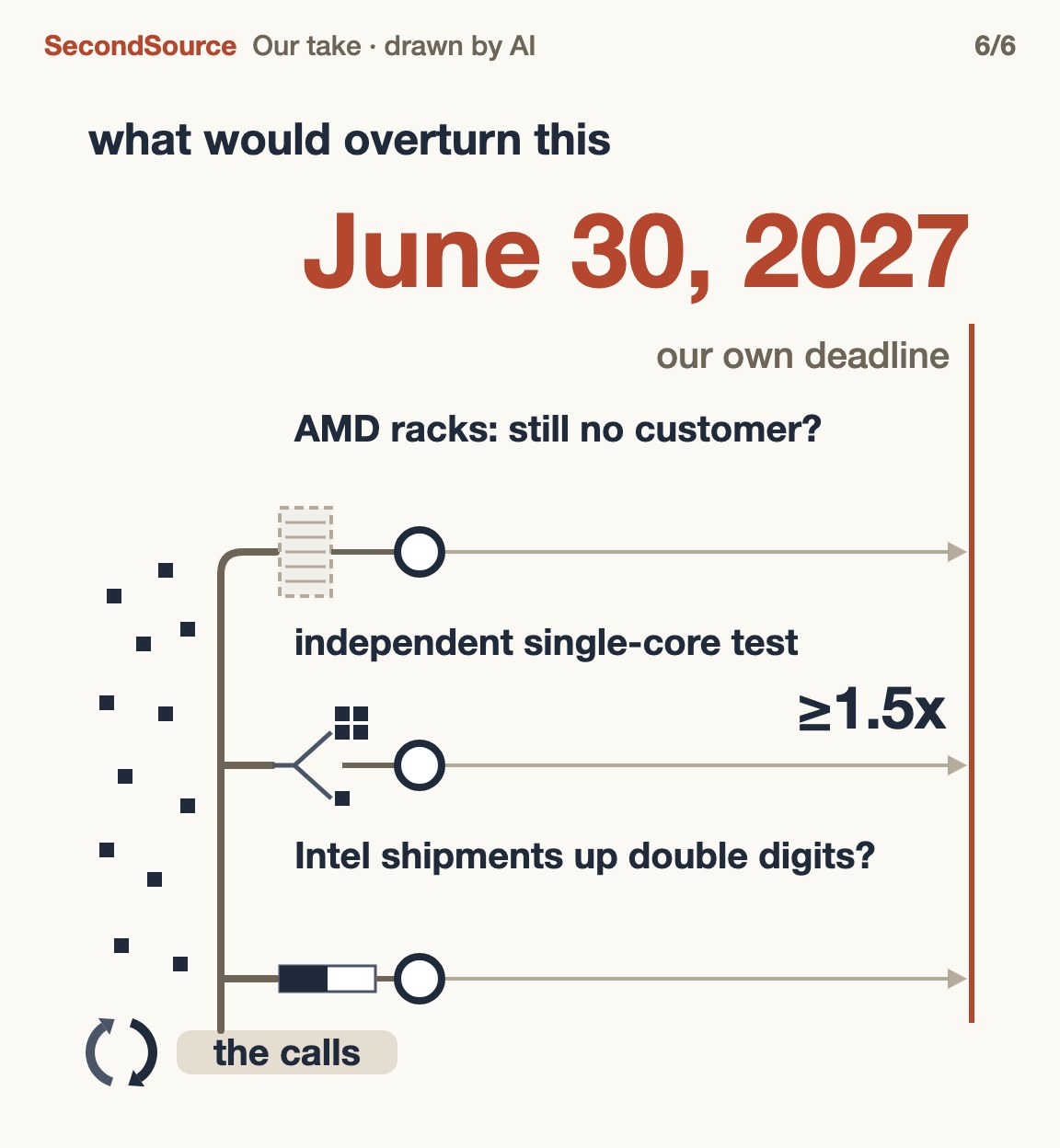
All three conditions below share a verdict date of June 30, 2027; the date and the thresholds are an observation window this publication set for itself.
1. By the verdict date, AMD's quarterly earnings press releases have never stated that the CPU-only Helion rack was delivered or deployed to any customer. AMD is the test because AMD bills the CPU-only Helion configuration as dedicated to agents (section one); it ships only from November, and it has no public buyer and no published price yet. If not even this one reaches any customer by the deadline, section two's reading is downgraded: what the four brought are options on spec sheets, not yet a product category that people buy.
2. An independent third party tests on the same agent workload and finds that Vera's per-core speed, or its speed per agent step, is at least 1.5 times that of the CPU it is compared with, and that density-oriented CPUs show no matching advantage in running sandboxes. Section four's "each path covers a different stretch" fails, and the single-core-speed path wins.
3. Intel's third- or fourth-quarter results show server volume growing by double digits year on year and the filing no longer says demand exceeds available supply, while AMD and Arm also report no shortage. Section five's "near-term business goes to whoever can deliver" fails: supply is no longer short, and buyers start choosing by design sooner.
Appendix: how the numbers were obtained
What was checked
The material for this piece is vendor press releases and product pages, Intel's 10-Q filing (the quarterly report US-listed companies file with the Securities and Exchange Commission), an arXiv paper, vendor and partner blogs, and reporting by analysts including SemiAnalysis, TrendForce and Futurum. Every "none" or "only" in the main text holds within that set; it does not mean that no one has bought.
Where each number comes from
| Number | What it measures | Who says so | Where |
|---|---|---|---|
| 32,768 cores | Maximum cores per rack, Helion CPU-only configuration | AMD, self-reported | AMD press release, 2026-10-12 |
| 256 CPUs, 22,528 cores, 400 TB | Maximum CPUs, cores and LPDDR5X memory per Vera CPU rack | NVIDIA, self-reported | NVIDIA product page and OCP blog |
| 46,000 cores, 133.45 kW | Cores and power per rack, some Xeon 6+ rack configurations | Intel, self-reported | Intel newsroom, OCP 2026 |
| 136 cores, 1.99x | Cores per AGI CPU; modeled work per 24 kW rack versus AMD's EPYC 9755 | Arm; Signal65, commissioned by Arm | As reported by Futurum |
| Tens of millions of cores | Graviton5 cores Meta deploys on AWS | Meta, AWS | End-of-April announcement, reported by TNW |
| 48 MW, 295 MW, about 1 to 6 | Fairwater's CPU and storage building, GPU cluster power, and their ratio | SemiAnalysis, on-site report | SemiAnalysis, 2026-02 |
| About 160, 30,000 cores, three million, nine in ten, 5% | DeepSeek's sandbox system: servers, cores, sandboxes a day, share using under 5% of requested allowance | DeepSeek | DSec paper, arXiv, 2026-09-19 |
| 1.8x | Vera's sustained per-core performance under agent workloads versus x86 | NVIDIA, self-reported | NVIDIA blog, 2026-07 |
| 1.5x, 1.9x | Perplexity's workflow speed and concurrent sandbox start-up speed versus its "current production reference" | Perplexity, own test | Perplexity blog, 2026-07 |
| 9%, 48%, 38% | Intel server unit volume growth; server average selling price growth for the quarter and the year to date | Intel | Intel second-quarter 10-Q (quarter ended 2026-06-27) |
| About half | Share of customer CPU demand Intel can meet | Intel's CEO, as reported | SiliconANGLE |
Details of the four vendors in section two
| Vendor | Product | Per-rack scale (vendor's figures) | Positioning | Timing |
|---|---|---|---|---|
| AMD | Helion CPU-only configuration (6th Gen EPYC, codenamed Venice) | Up to 32,768 cores | "dedicated capacity for agent execution and connections to separate model inference infrastructure" | Available November 2026 |
| NVIDIA | Vera CPU rack (MGX spec contributed to OCP) | Up to 256 Vera CPUs, 22,528 cores, 400 TB LPDDR5X | "tool calling, orchestration and sandboxed execution", split off from the Vera Rubin NVL72 racks that handle training and inference | First systems delivered |
| Intel | Xeon 6+ rack design (ORv3) | "select Xeon 6+ configurations scale beyond 46,000 cores per rack at 133.45 kW total rack power" | "The Intel AI for Enterprise Agent Toolkit is optimized and deployable on Xeon processors today" | On display |
| Arm | AGI CPU systems (Supermicro, Verda and others) | 136 cores per chip; Signal65, commissioned by Arm, puts modeled work per 24 kW rack at 1.99x the EPYC 9755 | Pitched by Arm as agentic AI infrastructure | Systems on sale |
Sources: AMD, NVIDIA blog and Vera rack page, Intel newsroom, Futurum on Arm.
Signal65's test was commissioned by Arm and is not an independent test. The four also name different buyers: AMD's press release points to hyperscale clouds, NVIDIA's first systems went to AI labs and Oracle's cloud, Intel is pushing an agent toolkit for enterprises, and Arm ships through system builders. The headline specs all four publish at the rack level are density figures: cores, power per rack, memory per rack. Those are spec-sheet numbers; they do not mean buyers choose on density. AMD's Helion also offers a high-frequency server configuration, and Arm's per-rack multiple includes single-core performance.
AMD also showed its next "agentic CPU," Verano, for the first time. TechTimes reports that the demonstration silicon used "six compute chiplets of 32 cores each" for up to 192 cores, with a 24-channel LPDDR5X memory system at about 2.9 TB/s, and that AMD targets volume production in the first half of 2027. AMD's press release itself gives no Verano specifications. Dan McNamara, who runs AMD's server business, said in the release: "Agentic AI is not a single workload. It spans personal agents, enterprise applications, code execution and complex workflows, each with different compute requirements."
NVIDIA unveiled Vera on May 31 and listed customers "exploring" it: NYSE, Anthropic, OpenAI, SpaceXAI, ByteDance, CoreWeave, Lambda, Nebius, Nscale and OCI. In July Perplexity published its sandbox platform and its Vera test numbers.
Purchase details for section three
- Meta and AWS: Santosh Janardhan, Meta's head of infrastructure, said the deal "allows us to run the CPU-intensive workloads behind agentic AI with the performance and efficiency we need at our scale." Amazon CEO Andy Jassy also mentioned the commitment on Amazon's first-quarter call.
- Microsoft Fairwater: SemiAnalysis wrote: "Here, a 48MW CPU and storage building supports the main 295MW GPU cluster." The same report says: "Frontier AI labs are running out of CPUs for their RL Training needs and are scrambling for CPU allocation by competing directly with the cloud providers for commodity x86 CPU servers."
- NVIDIA Vera's first deliveries: a caption on NVIDIA's product page says the first Vera CPU systems went to Anthropic, OpenAI, Oracle Cloud Infrastructure (Oracle's cloud, OCI) and SpaceXAI.
- CoreWeave: CoreWeave announced that "Rack-scale Vera at CoreWeave puts 128 CPUs and 11,264 cores in a single rack," supporting "more than 11,000 concurrent environments." On the shape of the load: "A single step in the loop can demand thousands of environments for an hour, then virtually nothing until the next run."
- Perplexity: Perplexity's July sandbox platform post says: "Over the last week, it has supported millions of sandbox creations and tens of millions of sandbox reconnects." Each task runs in its own Firecracker microVM, a lightweight virtual machine. On October 3 Perplexity's CEO said Perplexity Computer had started deploying on Vera, with the aim of running Perplexity's own sandboxes, optimized for the best silicon.
- Supply structure: hyperscale clouds first run their own workloads on in-house CPUs such as Graviton, Cobalt and Axion; merchant chipmakers AMD, Intel, NVIDIA and Arm sell to everyone else. Meta is on both roads: buying Graviton5 capacity from AWS while co-developing Arm's AGI CPU.
What changed from the October 13 issue's call
Based on the AMD and NVIDIA announcements, the October 13 issue made three calls: "agents push up CPU demand" had moved from a story on Intel's earnings calls to rack-scale products from two rivals; buyers would split capacity and power budgets into a GPU pool and a CPU pool; and AMD sells core density while NVIDIA sells single-thread speed, so whichever wins decides share. This piece corrects them: four vendors, not two, and the line began in March; the two pools hold, but what buyers buy is CPU capacity, not CPU racks by name; and the design question becomes two paths covering different stretches, with near-term share decided by supply. The two conditions that issue set for proving it wrong (no large cloud publicly buys CPU-only agent racks before the first half of 2027; the major agent platforms keep sandboxes in general-purpose cloud CPU pools) each hold only in part: CPU purchases have happened, while the whole rack as a line item has no public buyer.
Readings behind section four
- DeepSeek's DSec paper: DSec (DeepSeek Elastic Compute) was posted to arXiv on September 19 as sandbox infrastructure for training agents at scale. The paper says: "A single production-scale unit of DSec spans around 160 nodes, serving about 3 million sandboxes per day; in production, it supports over 380,000 concurrent sandboxes and sustains over 5,000 sandbox creations per second." The whole platform runs on close to 160 CPU nodes, 30,000 cores and about 250 TB of DRAM. Another reading: "approximately 90% of both container and microVM sandboxes use no more than 5% of their requested CPU capacity on average." Requested capacity is the CPU allowance each sandbox asks the scheduler for in advance. One node can host 800 microVMs or 3,200 containers. The nodes are standard two-socket x86 servers with high-core-count AMD EPYC 9655 chips.
- Self-reported single-thread numbers: NVIDIA's July post positions Vera as the "max single-threaded CPU at scale," arguing that per-core speed sets how fast the agent loop advances; NVIDIA reports 1.8 times the sustained per-core performance of x86 under agent workloads. Perplexity's own test found "actual Computer-style workflows ran roughly 1.5x faster than our current production reference, and started concurrent sandboxes up to 1.9x faster." CoreWeave says Vera starts agent sandboxes three times as fast as a single x86 CPU. The three measure different things: 1.8x is per-core performance, 1.5x a whole workflow, and 1.9x and 3x sandbox start-up speed. No source breaks down what limits start-up speed, which need not be single-core speed. No baseline names a chip model, and every number comes from the vendor or its partners.
- Self-reports pointing the other way: AMD claims "20% higher performance per core than NVIDIA's 88-core Vera" for Helion's servers. Burke points out that AMD's July agents-per-watt comparisons "are arithmetic from thread counts and power ratings under a theoretical workload." Both sides are self-reported, against different baselines.
- Burke's full judgment: after COMPUTEX, the Taipei computer show, in June, Burke wrote: "The two agentic CPU theses target different points of the agent lifecycle, which means the chips are more likely to prove complementary than substitutable." In Burke's reading, Intel's Xeon 6+ is tuned for density and concurrency in enterprise inference, and NVIDIA's Vera for orchestration speed and tight reinforcement-learning sandbox loops.
- One more limit: no independent test yet compares the two designs on the same workload.
Filing and price details for section five
- Intel's second-quarter 10-Q: the filing says server revenue rose "due to ASP increases of 48% and 38%, respectively" for the quarter and the year to date. "The majority of the increase in server ASPs was driven by a higher mix of premium products sold in Q2 2026 and YTD 2026, with demand-based pricing actions contributing to a lesser extent." "Server volume increased 9% compared to Q2 2025 and 2% compared to YTD 2025, primarily driven by higher hyperscaler demand." "Market demand exceeded our available product supply in Q2 2026 and YTD 2026 due to internal supply constraints."
- The CEO's remark: Intel CEO Lip-Bu Tan said in September at Splunk's conference that Intel could meet only about half of customer CPU demand, according to SiliconANGLE. The same report says Intel had raised its 2026 capital spending to more than US$20 billion.
- Prices: SemiAnalysis wrote in February that "Intel, facing the unexpected depletion of their CPU inventory, is looking to raise prices across their Xeon line." A TrendForce report at the end of September says "Intel and AMD responded by raising prices across select CPU product lines toward the end of 1Q26." The new round of increases that Taiwanese media reported in October is mainly on Intel's and Qualcomm's PC processors, with AMD reportedly preparing its own; that round is on the PC line, not the server line.
- AMD: AMD has raised its forecast for the 2030 server CPU market to more than US$200 billion.
- When the design contest can be measured: around the end of 2027, when AMD's Venice and Verano, NVIDIA's Vera and Intel's Xeon 6+ compete for the same server CPU sockets.
CPU-to-GPU ratios
TrendForce writes that "today's AI data centers operate at CPU-to-GPU ratios of roughly 1:4 to 1:8" and that "the future CPU-to-GPU ratio is expected to shift to between 1:1 and 1:2." Arm estimates that CPU cores per gigawatt rise from about 30 million to 120 million. Intel's CEO said in January that the ratio used to be one CPU to eight GPUs, is now one to four, and is heading toward parity or better. All of these are vendor or analyst estimates, and they mix chip counts, power and core counts. The only actual campus case in public data is Fairwater, at a power ratio of about one to six, storage included. Fairwater's is a power ratio, a different denominator from the chip-count ratios above, so the two cannot be compared directly.
The trend line this publication tracks
Where this sits on this publication's map: this trend was originally about the accelerator layer: training stays on GPUs, while the clouds move their own inference to in-house chips. With agent execution as a new layer, the same dividing line extends one step down. Clouds whose own workloads are fixed and large enough use in-house CPUs; everyone else buys merchant CPUs. The trend's original call is unchanged.
Written from the same research and judgments as the Traditional Chinese edition. Sources are linked; we distinguish original documents from reporting and mark what we could not verify.
Sources cited in other language editions
These sources are linked in the body of this piece's other language editions but not in this one.
- stratechery.com/2026/an-interview-with-nvidia-ceo-jensen-huang-about-accelerated
- stratechery.com/2026/intel-earnings-the-agentic-opportunity-intels-mistaken-pess
- stratechery.com/2026/intel-earnings-intels-differentiation-whither-terafab/
- x.com/Beth_Kindig/status/2076377926543515895
- youtube.com/watch
- x.com/jukan05/status/2109474246036791622