Deep Dive Oct 7, 2026
The "subsidy" in AI coding subscriptions sits mostly on the compute ledger, not the loss ledger: allowances mostly move with compute
Published October 7, 2026; rewritten October 23 to the current standard, with the call and the figures unchanged (the first version's structure is described in the appendix).
Key takeaways
On September 29, OpenAI halved the allowance for new subscribers on OpenAI's US$200 monthly plan; the allowance is the cap on how much the fee buys. In August this publication judged that heavy users burn compute (the chips and data centers that run AI) worth more than the fee, with the vendor absorbing the difference. That gap is the "subsidy", and once the subsidy became too costly, allowances would tighten.
The answer first: the subsidy is real, but the bigger part sits on the compute ledger (compute kept for subscribers when machines run short, not sold to API customers who pay per use), not the loss ledger (subscriptions losing money). The next two sentences give the numbers. From rough estimates by SemiAnalysis, a firm that often estimates the cost of AI compute, this publication calculates that API customers pay about 6 times what subscribers pay per unit of compute. SemiAnalysis assumes an API gross margin (revenue left after direct costs, as a share) of 92%, under which subscription revenue exceeds cost. So teams that code on subscriptions should expect allowances to loosen and tighten with the vendor's machines, not only to tighten.
Three takeaways:
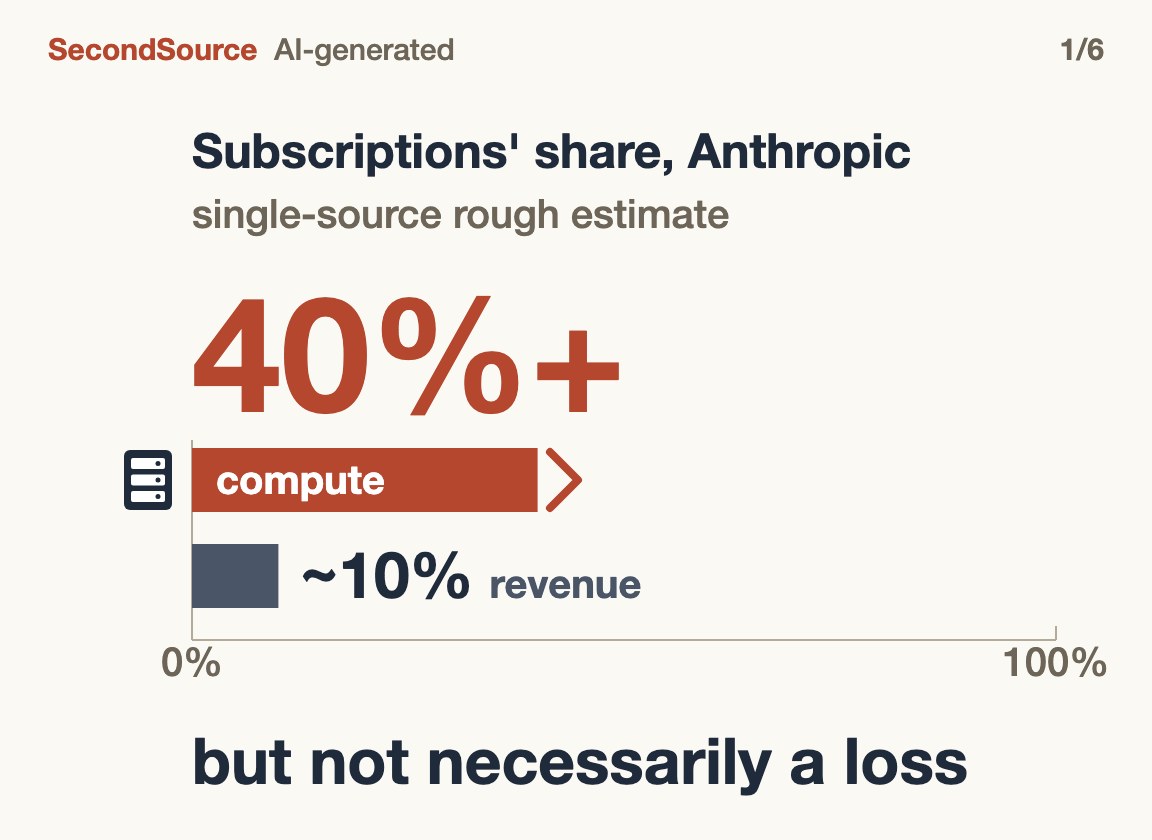
1. A tenth of revenue on two-fifths of compute, yet not necessarily a loss. SemiAnalysis roughly estimates (a single source) that subscriptions bring Anthropic only about 10% of revenue but use over 40% of compute. At the 92% above, that revenue still covers the cost. A tightened allowance is no sign that average subscribers lose money.
2. The September halving should not be read as the subsidy breaking down. Tightening began in 2025, and the model makers mostly cited short compute; Anthropic loosened allowances after securing new compute.
3. Scope. This piece covers only the subscriptions Anthropic and OpenAI sell directly. Losses at middle-layer firms such as Cursor and GitHub (companies that buy model usage and resell the usage inside the firms' own tools) show up directly on the books and fall outside this call.
The whole piece uses one yardstick: what the same unit of compute earns when sold to subscribers versus API customers. "The two customer groups" always means enterprise and API customers (who pay reliably and pay more per unit of compute) versus individual subscribers (whose heavy users are subsidized). The sections cover payment methods, the two customer groups, the timing of tightening, and then the two ledgers.
One: First, a few terms: subscription, allowance, compute, subsidy
AI coding tools are AI services that write and edit code for engineers: Cursor, Replit, GitHub's Copilot, and subscriptions such as Anthropic's Claude and OpenAI's ChatGPT Pro. There are two ways to pay:
- Subscription: a fixed monthly fee; this piece mostly discusses the US$200 tier. Allowances are usually set per 5 hours or per week.
- API: pay per use, at the vendor's published list price.
Usage is counted in tokens, the unit for measuring the text an AI model reads and writes; each short chunk of text is one token. The computation a model does to answer a request is inference, and compute in this piece always means the machines used for inference.
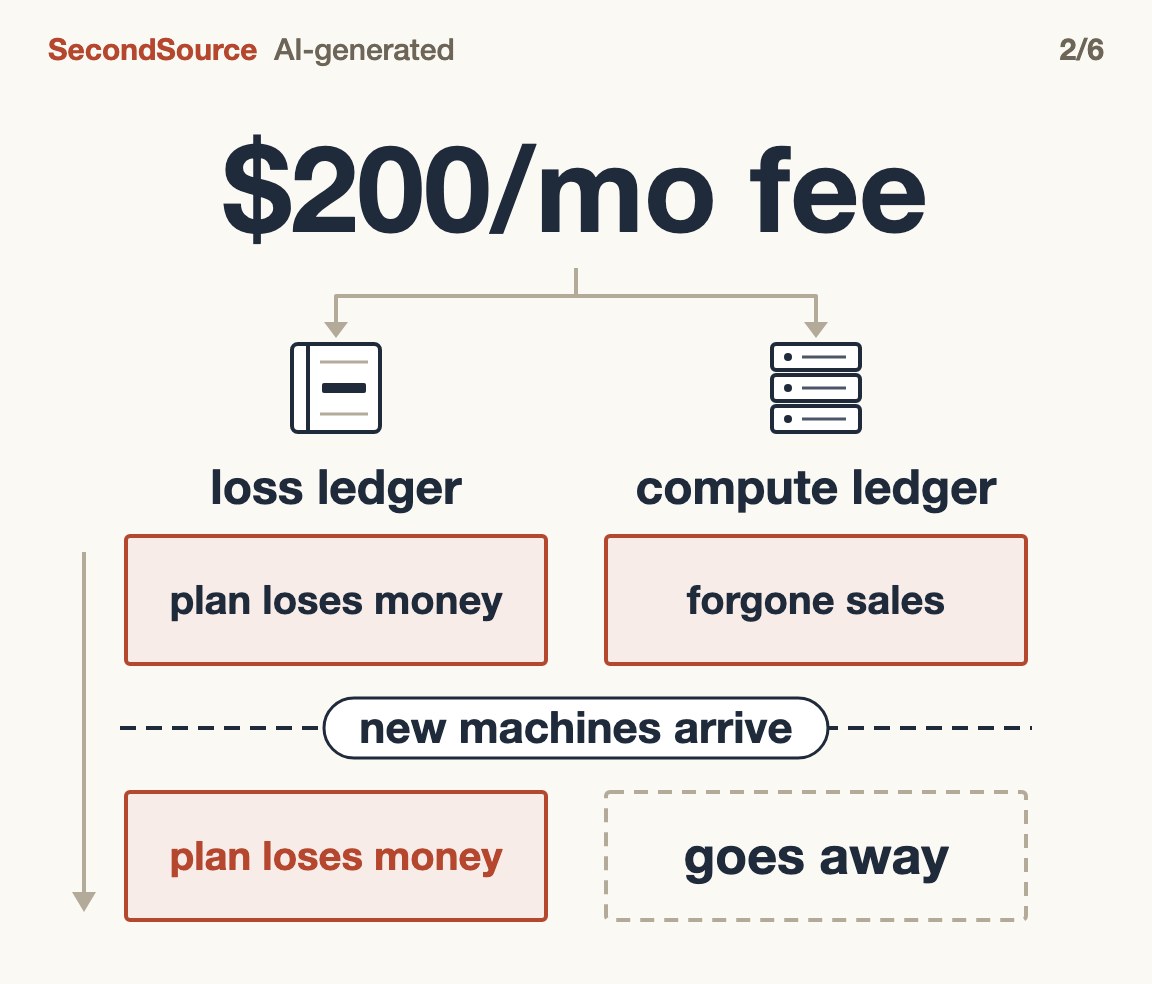
The two ledgers differ in when the pain arrives. On the loss ledger, each additional heavy user adds to the loss, whether or not machines are plentiful; on the compute ledger, the pain comes only when machines run short. So the two ledgers give subscribers different expectations: under the loss ledger, new machines would not bring allowances back; under the compute ledger, new machines would.
Two: The customers who make money and the customers being subsidized are two different groups
The August 8 issue said everyone was asking whether enterprises would cut AI coding budgets, but the real risk sat on the subsidy side.
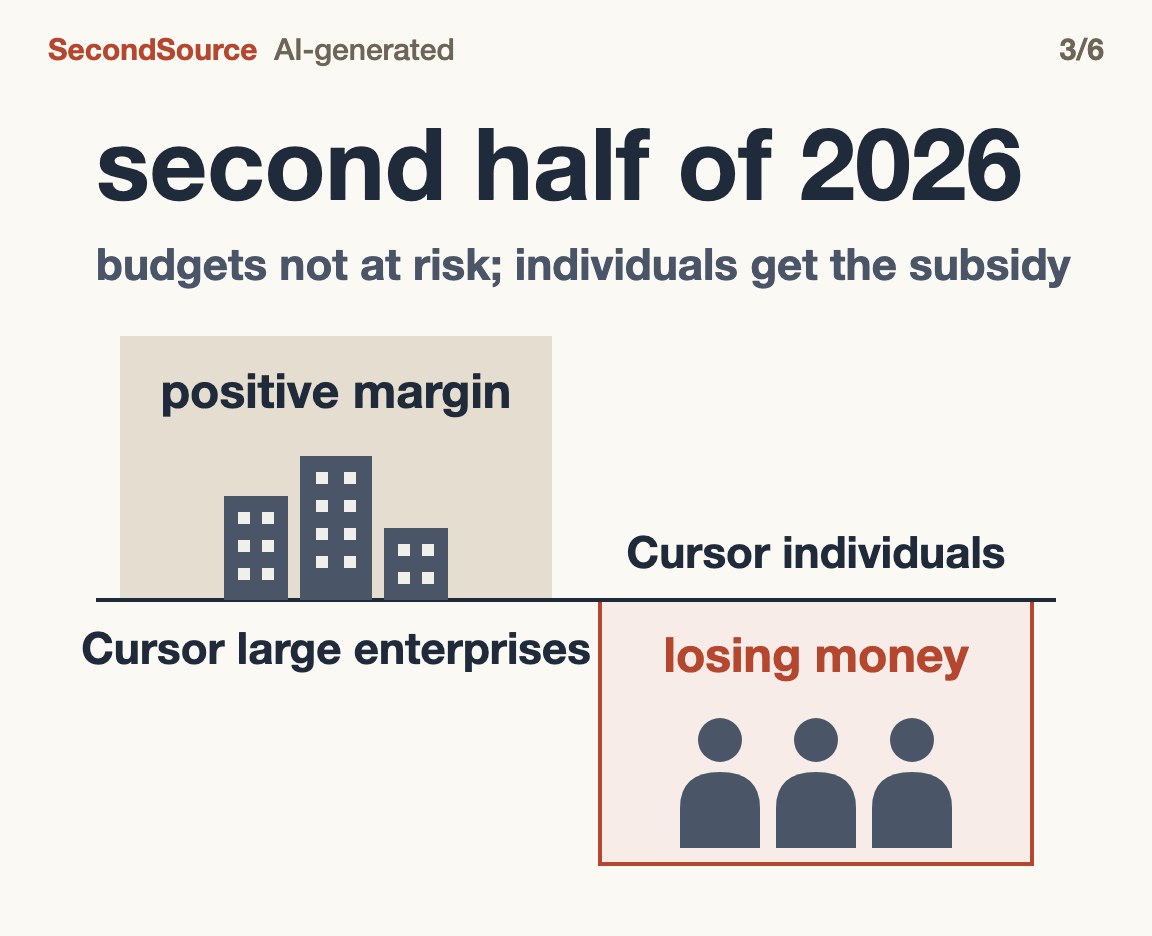
On enterprise budgets, SemiAnalysis interviewed more than 50 enterprises in June and combined the interviews with card data from Ramp, a platform that manages company spending. SemiAnalysis judged that AI budgets for the second half of 2026 carry no material risk, because spending is concentrated in large, very sticky customers. That study measures how much customers paid. This publication asks whether the money a vendor receives covers the compute that customer burns. Both can be true at once.
Two sources unconnected to SemiAnalysis support the two customer groups:
- Cursor: TechCrunch, a technology news outlet, cited sources on April 17 saying that Cursor's sales to large enterprises are already gross-margin positive, while individual developer accounts still lose money (the sources did not say whether the losses concentrate in heavy users).
- GitHub: on April 27, GitHub announced that Copilot would move fully to usage-based billing from June. The announcement said GitHub had "absorbed much of the escalating inference cost" behind that usage and that the current per-request model was "no longer sustainable".
So anyone judging the business by SemiAnalysis's enterprise interviews sees only the group that pays reliably; the subsidized users are a different group and need a separate look.
Three: Tightening began a year earlier, and the public reason was mostly compute
The second takeaway rests on allowance and pricing changes across vendors from 2025 to October 2026 (timeline in the appendix). Three things stand out.
First, tightening was under way a year before this publication made the call. Cursor, Replit and GitHub Copilot all changed allowances or pricing around June 2025; in July 2025, Anthropic added weekly caps. This publication's October 6 daily issue called the September 29 cut the first case confirming the August call. That sentence is withdrawn; the August call itself is not. SemiAnalysis also writes that vendors keep adjusting allowances alongside promotions and new model releases, so a single tightening proves nothing.
Second, the middle layer cites cost; the model makers mostly cite compute. Of the 2026 tightenings by Anthropic and OpenAI that came with a reason, most cited surging demand and short compute. For example, on September 10 OpenAI paused new sign-ups for the US$200 plan, citing demand for a new model that OpenAI called unprecedented. On September 29 the plan reopened, with the allowance for new subscribers halved. The halving came with no reason; this publication reads the two events together.
Third, allowances have been loosened once. In March 2026, Anthropic made the 5-hour allowance drain faster at peak hours, citing demand growth. On May 6, citing a contract with SpaceX for the full capacity of a data center, Anthropic removed the peak-hour reduction and doubled the 5-hour allowance. Loosening once compute was secured fits the compute ledger described in section one, but a signed contract is not a delivered machine. Competitors' offers matter too: SemiAnalysis writes that OpenAI's earlier generosity with allowances forced Anthropic to walk back planned subscription cuts again and again. The only sample with compute news to compare is Anthropic's March tightening and May loosening, and the compute shortage is each company's own account, not measured capacity.
So subscribers who want early warning of the next cut should not rely on plan terms, which change all the time. The better check compares each allowance change with announcements of new machines arriving in the same period.
Four: The "subsidy" has three calculations, and they measure different things
The "not necessarily a loss" in the first takeaway depends on how the subsidy is calculated. There are three ways:
1. API list-price equivalent: convert the subscription allowance into what the same usage would cost through the API. The title of a June SemiAnalysis article says a US$200 Claude plan can consume US$8,000 worth of tokens, 40 times the monthly fee. That measures the value the customer receives, not the vendor's cost, because the list price includes the vendor's profit.
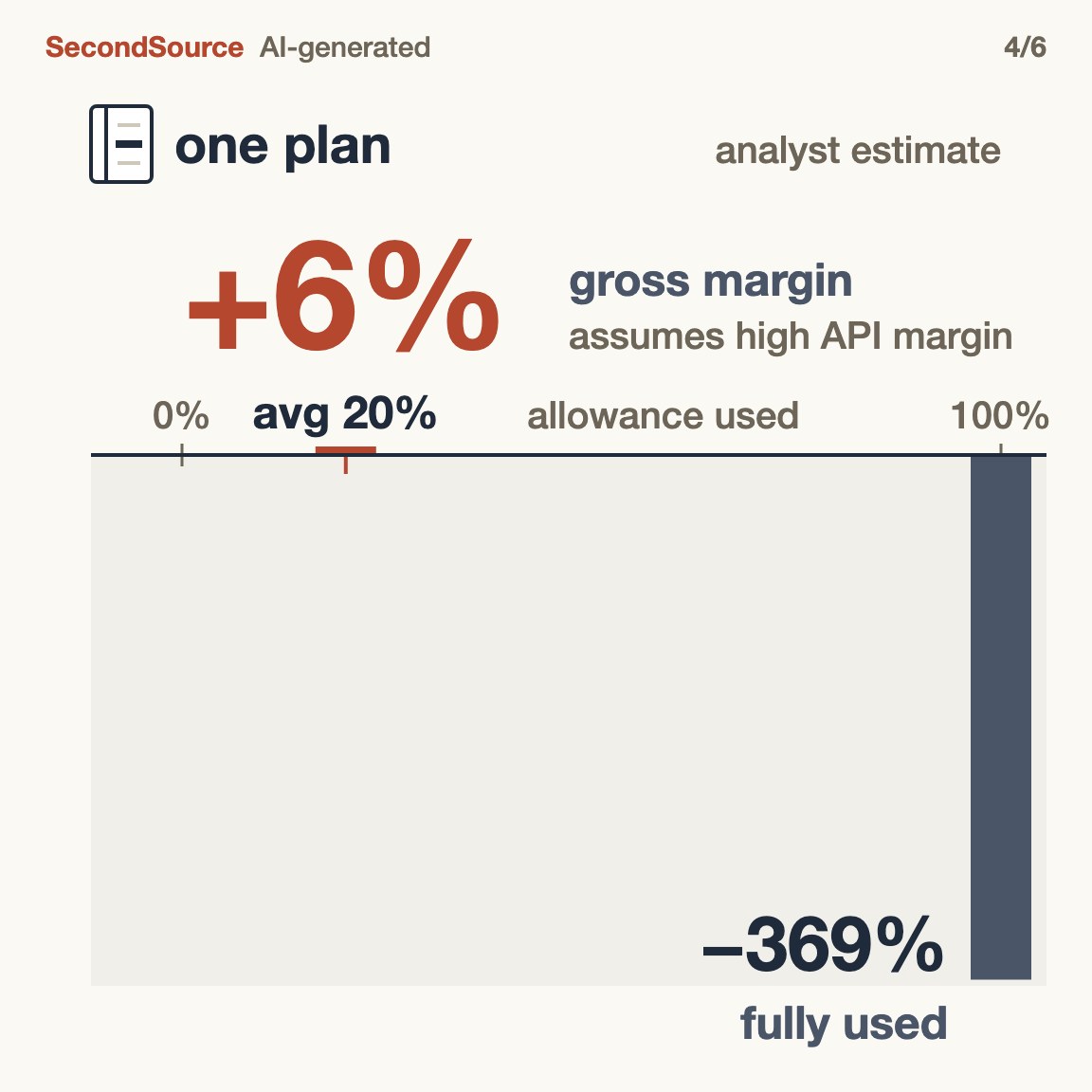
2. Cost with the allowance fully used: on October 5, SemiAnalysis assumed an API gross margin of 92% and assumed subscribers use 100% of the allowance. On those assumptions, Anthropic's US$200 plan running the mid-tier model Opus 5.5 has a gross margin of -369%. Opus 5.5 is a model name, not a plan name.
3. Cost at average utilization: the same article then switches to an average utilization of 20% (only a fifth of the allowance used), which SemiAnalysis considers more realistic. The same plan's gross margin becomes a positive 6%.
Side by side, the three calculations show that under these assumptions, subscribers with average usage do not lose money; the loss sits with the users who max out the allowance. The shape is inferred from two utilization levels, and vendors publish no distribution of utilization. Anthropic's July 2025 announcement said the weekly caps would affect under 5% of subscribers, which points the same way.
These numbers are sensitive to the 92%: a separate SemiAnalysis estimate in May says only that the gross margin of inference infrastructure is above 70% (section five shows the result at 70%). PitchBook and The Information have also reported Anthropic's company-wide gross margin at only around 40%, far below 92%. Public data cannot show whether this shortfall falls on free users, subscriptions or internal usage. So readers should treat the finding that average subscribers do not lose money as a result of the 92% assumption: if the shortfall comes mainly from subscriptions, that finding is too optimistic.
Five: Subscriptions use about 40% of compute and bring in about 10% of revenue
This section returns to the answer. Adding up all subscribers, the section compares the two ledgers for the whole company: profit and loss for the loss ledger, and opportunity cost for the compute ledger.
The two rough estimates from the first takeaway cover all of Anthropic's monthly subscription plans, not only coding; the figures below use 10% of revenue and 40% of compute. OpenAI has no comparable breakdown. From these, this publication estimates what each unit of compute earns. Suppose a company has 100 units of compute and takes in US$100. Subscriptions use 40 units and bring in US$10, or US$0.25 per unit. API and enterprise customers use 60 units and bring in US$90, or US$1.5 per unit. The two differ by about 6 times.
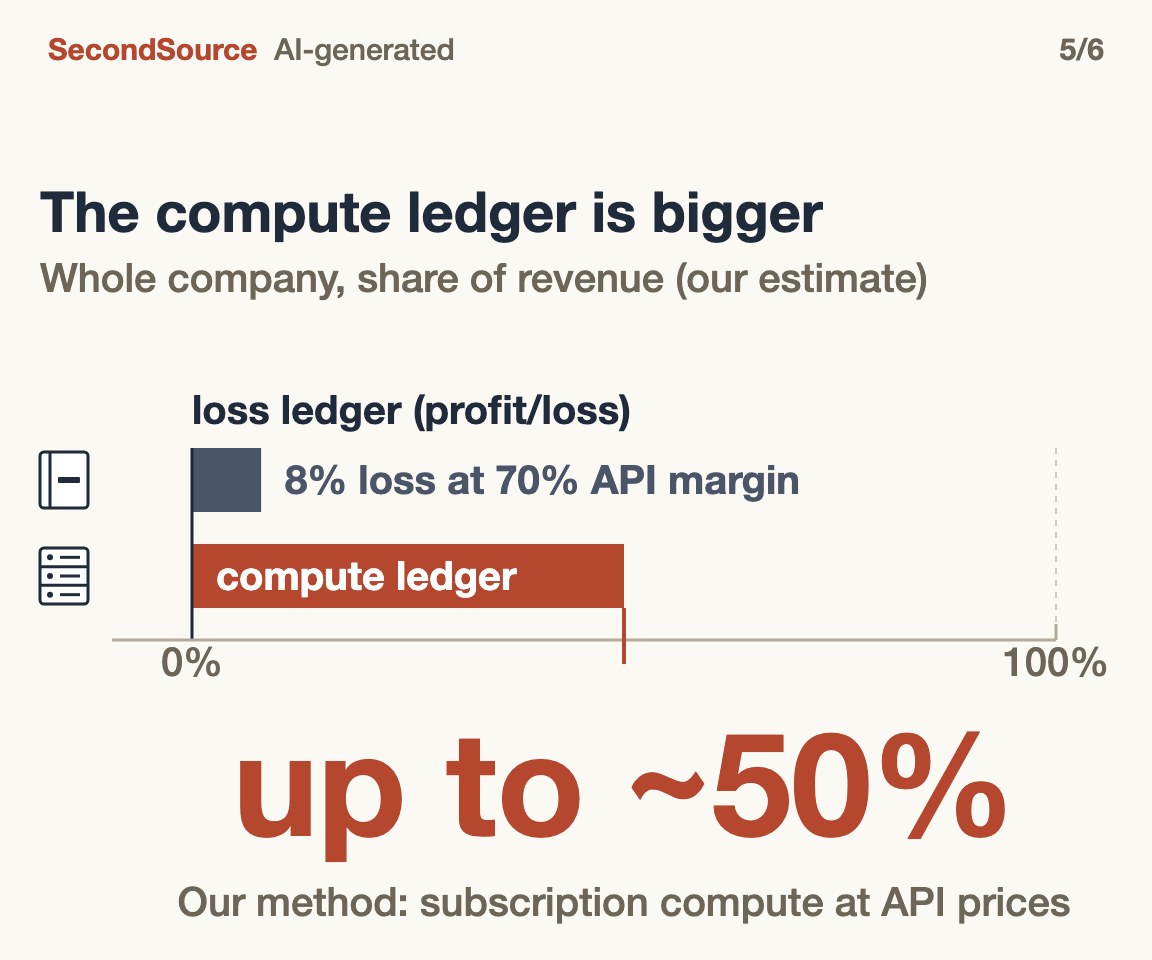
Profit and loss: cost is worked back from the API gross margin. The API earns US$1.5 per unit, so a unit costs about US$0.12 at a 92% gross margin and about US$0.45 at 70%. So at 92%, the 40 subscription units cost about US$4.8, and the subscription's own gross margin (with the US$10 of subscription revenue as the denominator) is about +52%. At 70%, the same units cost about US$18, more than the revenue, and the gross margin falls to about -80%. Section four's +6% is a trial calculation for one US$200 plan using only Opus 5.5 at a fifth of the allowance; the +52% here is the average across all subscribers, worked back from revenue and compute shares, and this piece's answer uses the +52%. Both agree that when the gross margin drops from 92% to 70%, the subscription business goes from profit to loss.
Opportunity cost: when compute is plentiful, idle machines serve subscribers; every extra dollar helps. When compute is short, the 40 units that subscribers occupy could go instead to API customers waiting in line, at US$1.5 per unit. That would bring in US$60, about US$50 more than the US$10 from subscriptions. That is an upper bound by this publication's estimate, assuming API demand really is queuing, prices hold, and machines can shift between customers.
In shares of company total revenue (with US$100 as the denominator), profit and loss is a gain of about 5% at 92% and a loss of about 8% at 70%. The opportunity cost reaches up to about half (50%). The loss of about 8% and the -80% in the previous paragraph describe the same case with different denominators. Selling to the API uses the same machines at the same cost, so the extra US$50 is roughly extra profit.
Six: Who this affects, and what would prove this piece wrong
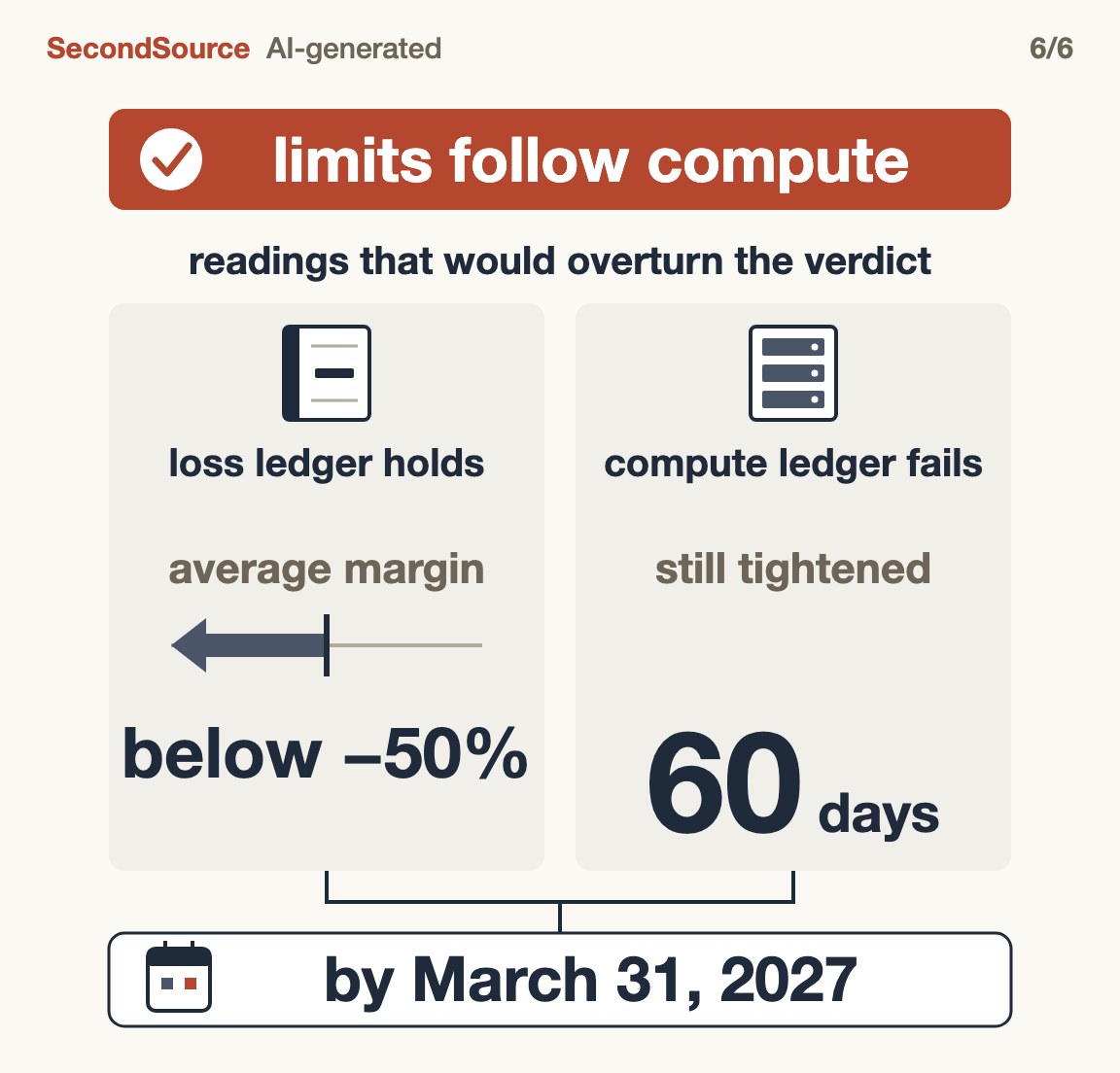
Back to the opening question: did the September halving mean the subsidy had broken down? No: section three shows that tightening mostly follows compute, and section five shows that when machines are short, the compute ledger weighs more in a vendor's decision on allowances.
Our call
As Anthropic and OpenAI take delivery of large amounts of new compute, subscription allowances should loosen first rather than keep tightening. The sample behind this reading is still small.
What this changes, and for whom
- Teams that rely on subscriptions for daily development: allowances get cut first when compute is tight, and may be changed silently (see the appendix). In OpenAI's September change, new subscribers paying the same US$200 got half the allowance, which roughly doubles the price per unit of allowance. Work that needs stable capacity belongs on API or enterprise plans whose contracts state the usage.
- Investors evaluating AI coding startups: ask for the gross margin of enterprise and individual accounts separately, not just the number of paying users.
What would prove this wrong
All four conditions share a verdict date of March 31, 2027, set by this publication.
1. A vendor discloses, or a firm other than SemiAnalysis estimates, that subscriptions at average utilization run a clearly negative gross margin (for example below -50%). This would overturn the finding that subscriptions themselves do not lose money: subscriptions would lose money even with machines to spare, and the loss ledger would be the larger one.
2. Anthropic or OpenAI still tightens allowances on existing plans within 60 days of announcing a large delivery of new compute. This would overturn the reading that allowances follow compute; the driver of tightening should then be read as pricing or losses.
3. Anthropic's gross-margin breakdown becomes public (for example in listing documents) and shows that the shortfall between company-wide and API gross margin comes mainly from subscriptions. Then the profit-and-loss figures in sections four and five must be recalculated, with the loss ledger revised upward.
4. Widespread cuts to AI coding budgets appear on the enterprise side. This would overturn the section two view that enterprises pay reliably.
Appendix: how the numbers were obtained
Timeline of allowance and pricing changes
Allowance and pricing changes at the main coding tools from 2025 to October 2026, in date order:
| Date | Vendor | Change | Public reason |
|---|---|---|---|
| June 2025 | Cursor | Pro plan changed from 500 requests to US$20 of frontier-model usage, plus a new US$200 plan; apology and refunds afterwards | Cost: the hardest requests cost an order of magnitude more than simple ones |
| June 2025 | Replit | Moved to effort-based pricing | Cost: align charges with the compute actually consumed |
| June 2025 | GitHub Copilot | Monthly allowance for premium requests, overage billed separately | No cost statement found |
| Announced July 2025, effective end of August | Anthropic | Weekly caps added to the Pro and Max plans, estimated to affect under 5% of subscribers | Heavy users running nonstop in the background; one user consumed tens of thousands of dollars on a US$200 plan (Anthropic did not say whether at list price or at cost) |
| March 2026 | Anthropic | 5-hour allowance drains faster at peak hours; about 7% of users expected to hit the cap | Compute: responding to demand growth |
| March to April 2026 | Anthropic | Default reasoning effort lowered from high to medium (the longer a model thinks before answering, the more compute each answer uses); reversed about 5 weeks later | Latency too long; later called a wrong trade-off |
| April 2026 | Anthropic | Subscriptions no longer cover third-party agent tools | Compute: priority for Anthropic's own products and API customers |
| Announced April 2026, effective June | GitHub Copilot | Fully usage-based billing | Cost: no longer sustainable |
| May 6, 2026 | Anthropic | 5-hour allowance doubled, peak-hour reduction removed (loosening) | Compute arrived: contract with SpaceX for the full capacity of a data center |
| August 30, 2026 | Anthropic | Weekly-cap promotion ended, a net cut of about 17% (according to a secondhand estimate) | Compute management and platform stability |
| September 10, 2026 | OpenAI | New sign-ups for the US$200 plan paused | Compute: unprecedented demand for a new model |
| September 22, 2026 | Anthropic | Subscriber caps raised on a new model's release day (loosening) | No figure given |
| September 29, 2026 | OpenAI | US$200 plan reopened with the allowance halved for new subscribers; new US$500 plan | No cost statement found |
- The default reasoning-effort row matches the August call's cheaper model served behind the same monthly fee. Anthropic attributed the change to latency and did not say the aim was to save cost.
- Anthropic's August 30 net cut was also attributed to compute management, so this publication does not count the cut as a case of tightening while compute was loose. That is also exactly where the sample is too small.
Revenue and profit per unit of compute (this publication's estimate)
All inputs are SemiAnalysis rough estimates: subscriptions account for about 10% of revenue and more than 40% of inference compute. If the actual shares differ, every number below changes. The example follows the main text: a company with 100 units of compute takes in US$100.
| API gross margin 92% | API gross margin 70% | |
|---|---|---|
| Cost per unit of compute (API revenue of US$1.5 per unit × (1 − gross margin)) | About US$0.12 | About US$0.45 |
| Cost of the 40 subscription units | About US$4.8 | About US$18 |
| Gross margin of the subscription business (revenue of US$10) | About +52% | About -80% |
| Share of company total revenue | Gain of about 5% | Loss of about 8% |
- This is a company-level rough calculation from revenue and compute shares. The inputs differ from SemiAnalysis's per-plan calculation in section four (a positive 6% at 20% average utilization), so the two sets of numbers cannot be compared directly, and this publication cannot break down the gap between the two.
- Opportunity cost when compute is short: 40 units × US$1.5 − US$10 = US$50, or half (50%) of total revenue.
- The test: if the profit or loss at the heavy-user end is only a single-digit percentage of revenue, the subsidy is an affordable marketing cost. SemiAnalysis also says subscription subsidies are heavy but may still make sense as a tool for acquiring customers and for marketing.
Other readings
- Ramp's spending distribution: the Ramp customer at the 99th percentile spends nearly US$90,000 per employee per year; the median Ramp customer spends only about US$136. The original does not say whether the median figure is also per employee per year, so the two are not compared directly.
- The top-tier model Fable 5.1: under the same SemiAnalysis calculation, the US$200 plan running Anthropic's top-tier model Fable 5.1 has a gross margin of 1% with the allowance fully used and 80% at 20% average utilization. The plan lets Fable use at most half of the allowance. That explains only part of the gap, and this piece does not break down the rest.
- The two vendors tighten differently: in SemiAnalysis's October testing, OpenAI halved allowances across every model tier, while Anthropic gives newer, more expensive models less allowance. On the same-priced plan, Anthropic's mid-tier Opus 5.5 offers about 5 times the API list-price equivalent of OpenAI's mid-tier model. That is value converted at list prices. List prices differ between vendors, so 5 times the value does not mean 5 times the work. The OpenAI generosity with allowances mentioned in section three refers to an earlier period.
- Revenue forgone per MW: SemiAnalysis estimates that subscriptions lower revenue per MW, across subscriptions and API combined, by about US$36 million. MW (megawatt) measures a data center's electrical capacity. The original does not state the period or the baseline, and this publication has not recomputed the figure.
- Silent allowance changes: in SemiAnalysis's testing, one vendor lowered the allowance on only some accounts of the same subscription.
- Overspending on the enterprise side: SemiAnalysis's June study mentions Uber using up an annual budget in 4 months. According to The Register, a McKinsey survey found that most enterprises overspent. So far there are only cases like these; overspending is not the same as cutting, and overturn condition 4 has not been met.
Measurement notes
- The magnitude in the August call originally came from an example posted on X by Armin Ronacher, the author of Flask, a framework for building web applications: a US$200 subscription that consumed US$2,000 of tokens.
- Sources for the three subsidy calculations: the 40 times and US$8,000 come from the title of SemiAnalysis's June article; -369%, a positive 6% and 92% come from SemiAnalysis's October 5 article; above 70% comes from SemiAnalysis's May estimate of inference-infrastructure gross margin.
- For budgeting, the worst case can be estimated at the API list-price equivalent, which can reach 40 times the subscription price (item 1 in section four).
- This piece's inferences, not vendor statements: allowances follow compute, and the opportunity cost of about half (50%) of revenue.
- Disclosure: this publication's analysis is produced with help from Anthropic models, and Anthropic is one of the subscription vendors discussed in this piece.
- The October 7 first version of this piece set out the call in three layers: the two-groups structure holds; the claim that the prediction came true is half withdrawn; once the subsidy is broken apart, the larger part is compute. This version keeps the call and the figures and changes the order, the length and the plain-language explanations. The allowance timeline and the details moved to the appendix, and the appendix adds the gross margin of the subscription business itself, next to the share of company total revenue.
The trend line this publication tracks
This publication charts the business of model companies selling tokens as the tree below. First, chips, power and memory captured the value, and model companies lost money selling tokens; in the first half of 2026, per-token economics turned positive. Three views now argue over what comes next, and the parentheses name the analysts or commentators who hold each view. Path A holds that shortages plus a quality gap let model companies keep pricing power. Path B holds that tokens will become an undifferentiated commodity, with margins pushed back down to cost. Path C holds that today's demand is padded with subsidies, and that the padding will show once funding tightens.
Open ?
Where this piece sits on the trend line: the three paths argue over API gross margin. This piece adds another angle: the margin on the subscription side is not mainly being pushed down by competition; subscriptions serve as a valve when compute is short. That gives path A an observable reading. If pricing power is only a temporary rent during the shortage, subscription allowances should loosen first when the shortage ends.
Sources
- SemiAnalysis, 2026-10-05: Anthropic Subscriptions Offer 5x+ More Value Than OpenAI
- WinBuzzer, 2026-09-30: winbuzzer.com/2026/09/30/openai-adds-500-chatgpt-pro-cuts-allowance-new-200-subs
- X / @mikeyk, 2026-09-22: x.com/mikeyk/status/2102441797482152313
- SemiAnalysis: TokenBudgeting: Our Conversations with Enterprises on Token Spend
- X / @mitsuhiko, 2026-08-04: x.com/mitsuhiko/status/2084563924435845350
- X / @teortaxesTex: x.com/teortaxesTex/status/2084492223962362331
Written from the same research and judgments as the Traditional Chinese edition. Sources are linked; original documents are kept distinct from reporting about them, and unverified points are marked as such.