Deep Dive Sep 19, 2026
Data-center opposition reached the US election, and it lands on governors' executive orders. Most candidates want data centers to bring their own power, not a building ban

Published September 19, 2026; rewritten October 23 to the current standard. The main call is unchanged.
Key takeaways
Opposition to new US data centers reached the election this year. On August 20 a Republican Senate candidate in Michigan switched to backing a one-year pause on new data centers, which looked like resistance moving up to the federal level. The record says no. The candidate said plainly that he does not support a federal ban, and the federal ban bill has had no committee vote. States and local governments issue data-center permits, so the official who can sign a ban after the election is a governor. A governor signs an executive order, which the next governor can revoke. What the election changes is who signs and on which day. By the reading of MultiState, a firm that tracks state policy for companies, most candidates want data centers to bring their own power and pay the full cost, and a blanket ban is the minority position. For most developers that is an added cost, not a closed door; developers who can generate on site come out ahead, and only a blanket ban in a minority of states can stop them.
One: First, a few terms: pause orders, who can issue them, on-site power
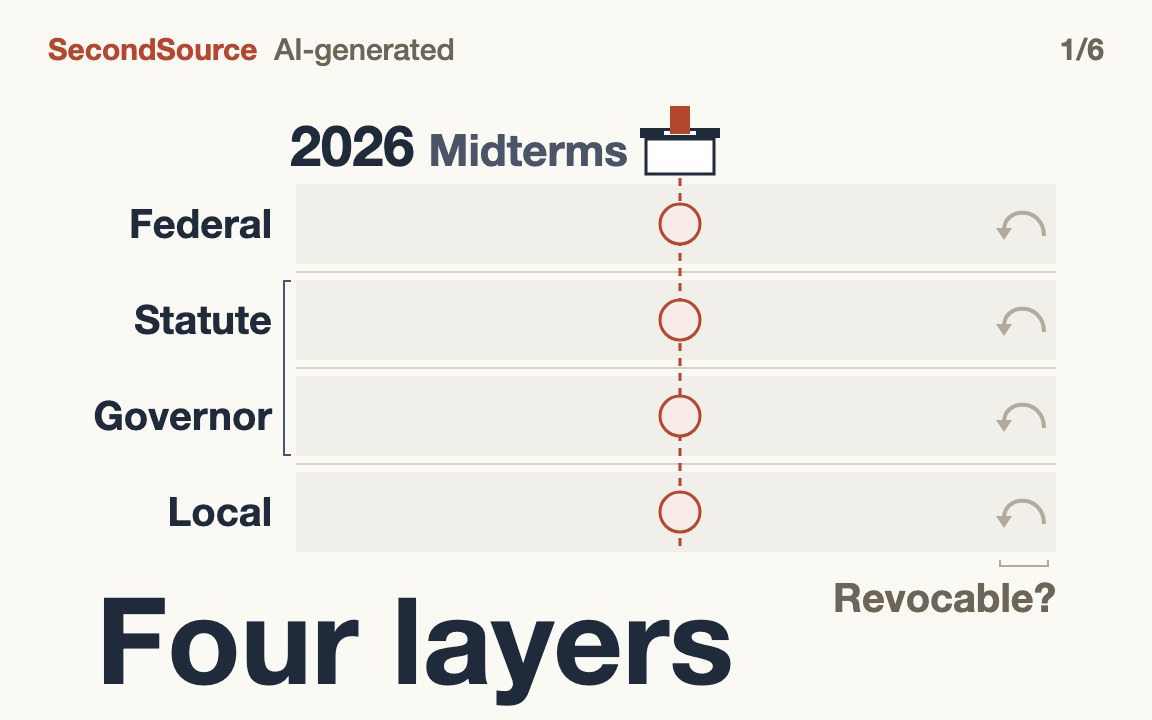
Local opposition to new US data centers usually cites higher power bills, water use, and communities having no say. The question here is which level of government turns that resistance into a binding rule, and with which tool.
A pause order, or moratorium, is a government decision not to approve new data centers for a period; "ban" here means the same thing. A pause covering every new data center, wherever the power comes from, is a blanket ban. The other approach is not to ban but to attach conditions; the most common, below, is self-supplied power.
State and local governments issue data-center permits. Four levels can issue a pause, differing in how easily each can be undone:
- Local governments (counties and cities): can stop accepting applications, and can be pushed to lift the pause when a developer sues.
- A governor's executive order: signed without the state legislature; a successor can revoke the order.
- State legislation: passed by the legislature; a new governor does not undo it, only new legislation can, but it is hard to pass.
- A federal bill: passed by Congress and binding nationwide.
This piece says an official "holds the pen" when, once elected, that official can sign or veto a ban.
Developers have had two tools for handling resistance. One is negotiating with local government case by case, using community-benefit payments (money the developer pays the community) and tax agreements to win approval. The other is on-site generation. A data center uses a lot of power and normally waits in line for the grid operator (the utility that transmits and delivers electricity) to approve the connection. Building generators next to the site, mostly gas-fired and called behind-the-meter in the industry, skips the line. When candidates say data centers should bring their own power, two routes qualify: generating on site, or paying the full cost of grid expansion. Both make the developer pay; neither stops construction.
2026 is a US midterm year, the election in the middle of a presidential term, and many states elect a governor and a US senator at the same time.
Two: The August 20 report was neither the first such pledge nor a federal one
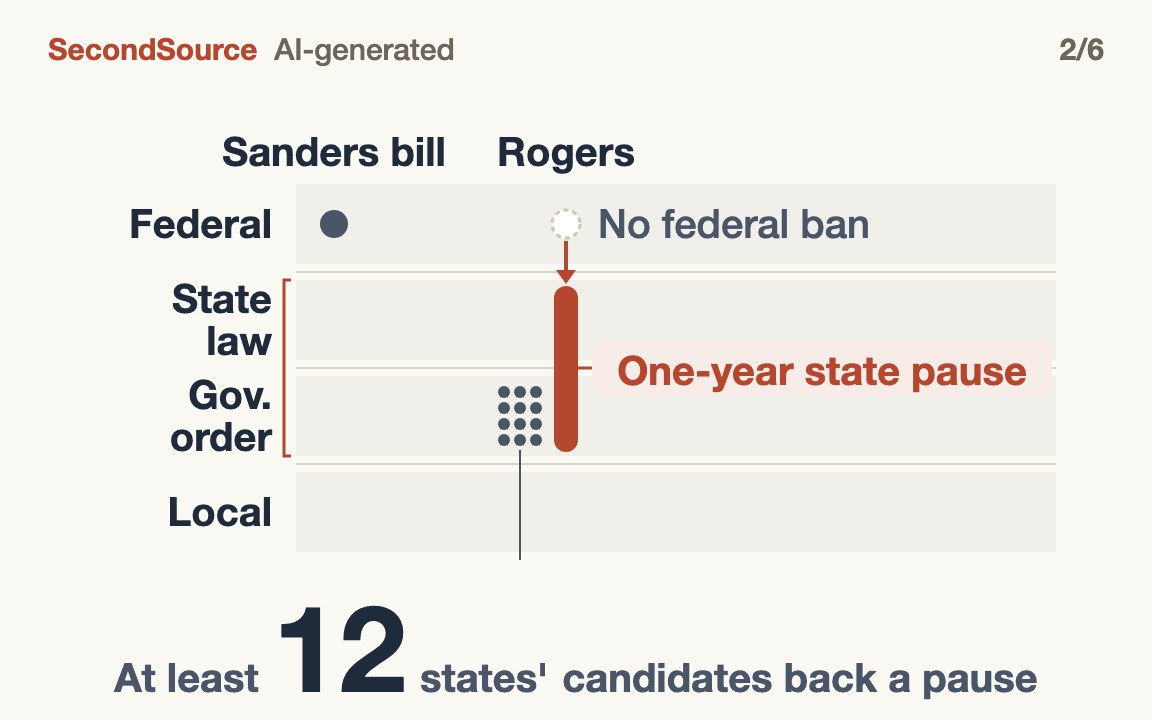
On August 20 the Detroit News reported that Mike Rogers, Michigan's Republican candidate for the US Senate, supported a one-year pause on new data centers. At first sight this was the first time data-center resistance became a federal campaign pledge. On checking, neither "first" nor "federal" holds.
Rogers opened by saying that he does not support a federal ban and that Michigan needs stronger guardrails. Rogers wants a one-year Michigan pause approved by state decision-makers, during which the state sets up an approval process that puts local communities first.
Pause proposals were already in the election before that. On March 25 Senator Sanders and Representative Ocasio-Cortez announced a federal AI data-center moratorium bill. On July 21 Newsweek counted candidates for governor in at least 12 states who supported a pause. On August 8 Rogers's Democratic opponent, El-Sayed, called for no new approvals until federal guardrails exist, 12 days before Rogers.
So what was new on August 20? In the coverage reviewed, Rogers is the first Republican Senate candidate in a swing state (a state either party could win) to switch to supporting a pause. Earlier that week the National Republican Senatorial Committee (NRSC), which runs Senate campaigns for Republican candidates, circulated an internal memo. The memo called data centers a sleeper issue for the midterms, meaning one that stays quiet but can swing votes. The memo warned that the opposition would spread to more states. Only the order of events is visible, not whether the memo caused the switch. What is clear is that the party machine has started to manage data centers as a campaign risk, which is not a federal move toward a ban.
Three: A Senate candidate cannot deliver a ban; a governor can
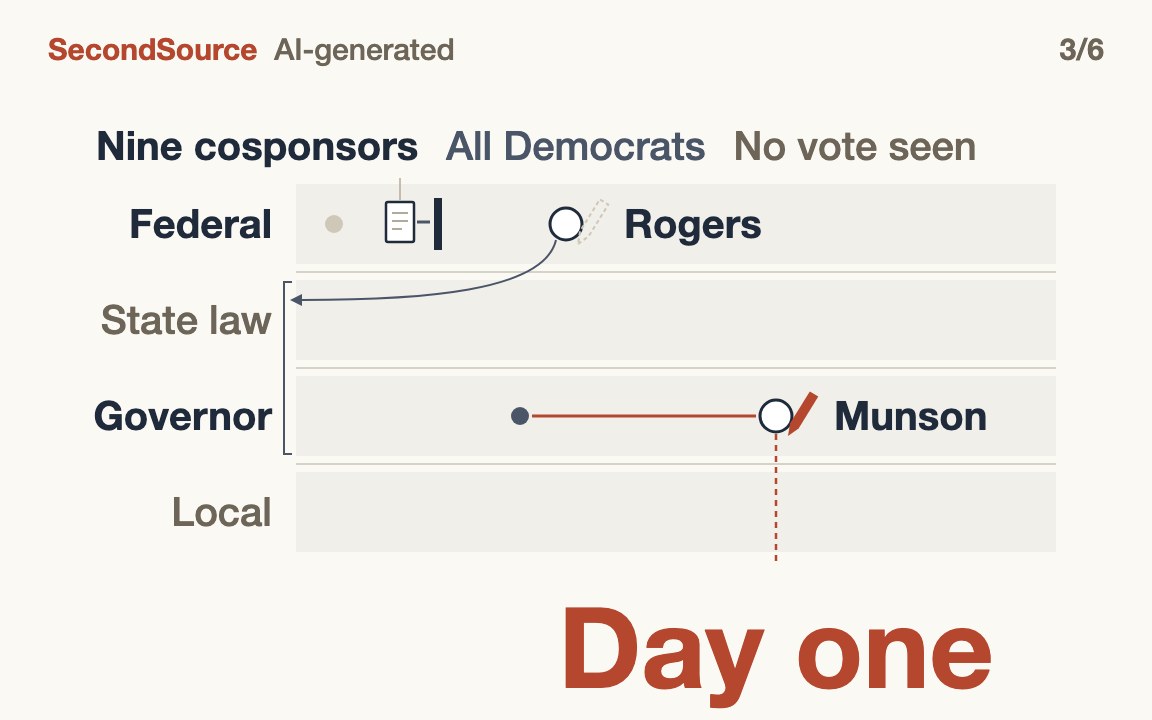
Whether a campaign pledge becomes policy depends on whether the person who made it has the power to act once elected (supporting research is in the appendix):
- Candidates for the US Senate: a senator holds no pen, so a Senate seat cannot deliver the Rogers pledge.
- The federal bill: the House version of that bill was formally introduced on June 24, with nine cosponsors, all Democrats. The pause lifts when Congress passes a set of AI laws, including pre-market review of AI products, so the bill is really about AI. A bill needs a committee vote before a floor vote; as of September 19 none could be found, so it is still at step one.
- Candidates for governor: these are the people who hold the pen. Cyndi Munson, Oklahoma's Democratic candidate for governor, pledged to sign an executive order imposing a pause on her first day in office. Maine's sitting governor vetoed a pause bill the legislature passed this year; candidates from both parties to succeed the governor support a pause, and the Democrat, Pingree, has said she would sign such a bill. If the legislature passes it again and a new governor signs, it becomes state law.
Four: A governor's pen is still the executive order. The election changes who signs, and on which day
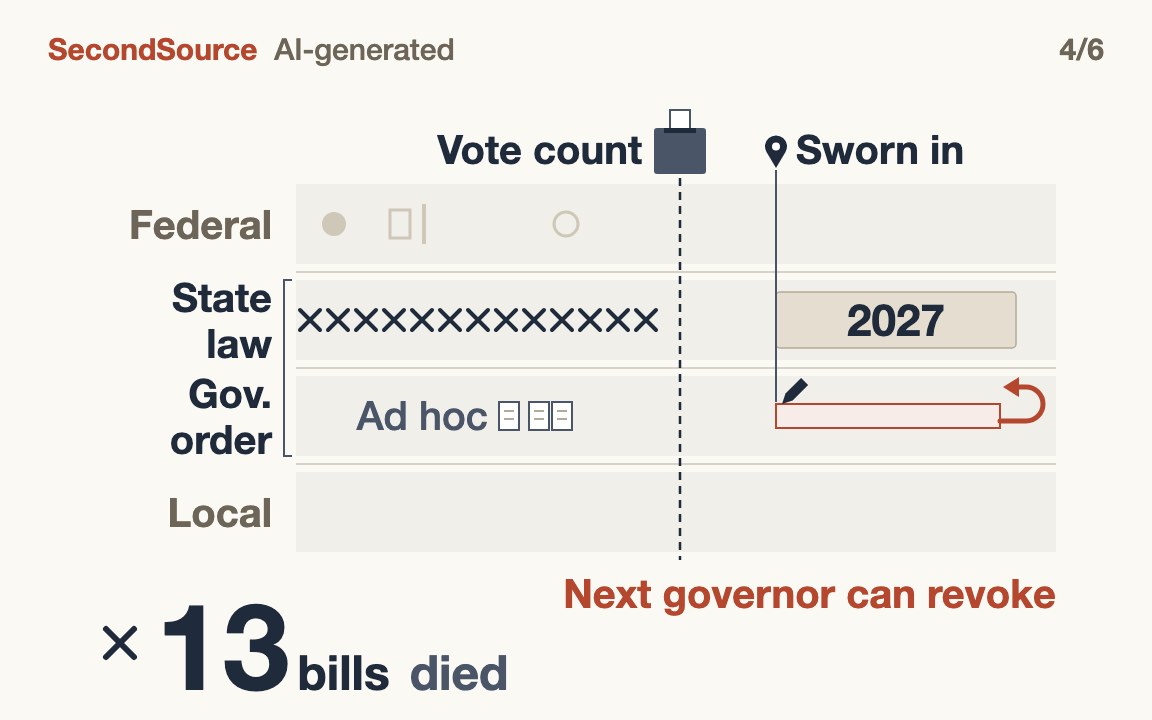
The fastest tool a governor has for keeping a pledge is the executive order. SemiAnalysis, a research firm covering semiconductors and data centers, wrote in a September 15 survey of pauses that the governors of New York and Texas "bypassed their legislatures to impose pauses they can ultimately control and revoke". The Texas order reportedly called for an audit of data centers waiting to connect to the grid; the queue stalled during the audit, so SemiAnalysis counts the audit order as a pause. State legislation is harder to undo, yet SemiAnalysis counts 13 such bills dead this year.
So far, every state-level pause in force is a governor's executive order. Maine and Ohio candidates seek legislation; passed without an on-site exemption, it would trigger section seven's first condition. The election changes two things.
First, the election decides who signs, and the date is known in advance. Over the past year governors' orders landed without warning (a New York pause on July 14, a Texas audit on August 3; the Pennsylvania order of August 18 is no pause but a set of conditions). A sitting governor can still sign at any time, but in states where a pro-pause candidate can win, the biggest risk sits on a known calendar: votes counted on November 3, inauguration in January, then the 2027 legislative sessions.
Second, revoking gets more expensive, but only for the governor who signed. Our inference is that a governor elected on a first-day pause pledge who then withdraws the order faces the voters and allies who delivered the win, a higher political price than for a governor who signed on short notice. Local pauses do not even carry that price and fall faster: Hill County, Texas, passed a one-year pause in May and lifted the pause after a developer filed a federal lawsuit in June. The election makes revoking costlier; it does not turn an executive order into law.
Five: The campaign mainstream asks data centers to bring their own power, and that makes on-site generation more valuable
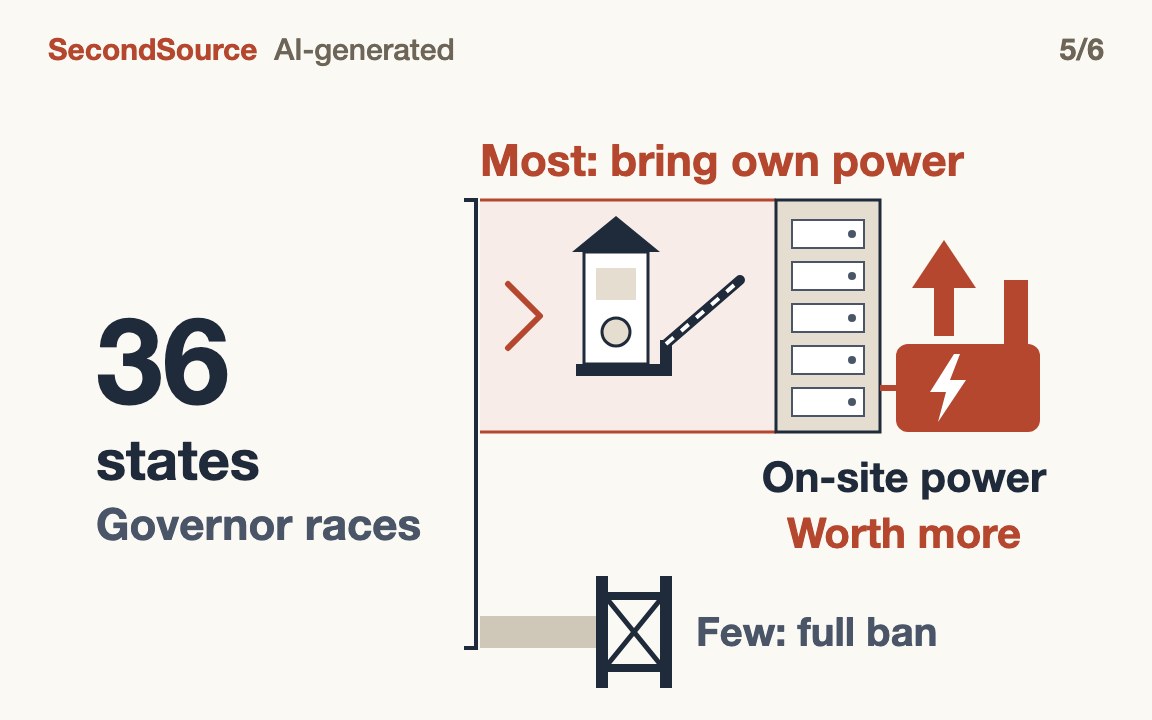
If the campaign produced blanket bans, both of the developers' tools would fail at once: the ban covers the data center itself, wherever its power comes from. But what the campaign is producing is mostly conditions, not blanket bans.
MultiState surveyed on September 1 the governors' races in 36 states where candidates are debating data-center policy. MultiState's conclusion is that most candidates support data-center development but want stronger rules, above all a requirement that facilities pay for the energy infrastructure they need. That is a qualitative reading, with no candidate-by-candidate count.
The named examples point the same way:
- Texas Governor Abbott: beyond the audit, his data-center guardrails are conditions: no taking water the community needs or power the grid needs.
- Pennsylvania Governor Shapiro: the August order ties state permits to local consent and requires developers to follow his grid standard: build, bring or buy the full generating capacity the site's own load needs, and pay the full cost.
The developers who can pay that cost are the ones generating on site. This is a directional call; this piece has no cost comparison between the two approaches. SemiAnalysis read Texas the same way: the queue stalls, "but is offset by an acceleration of behind-the-meter demand".
Only a blanket ban stops on-site generation: Rogers would pause all new data centers, and the federal bill has no exemption, but neither can deliver yet (section three). On-site generation has two more limits: gas generators trade a grid dispute for a local fight over air pollution and noise, and Abbott's guardrails also cover water.
So the two tools do not fail together: case-by-case negotiation is getting harder, because candidates who need a public position have joined the other side of the table, while on-site generation gains value.
Six: The ballot payoff is uneven, and the industry is already spending on the election
Public opinion points one way: in Gallup's March survey, 71 percent of Americans opposed an AI data center being built near home. Whether a pause pledge wins votes is less clear. Nancy Mace (South Carolina's primary for governor) and Francesca Hong (Wisconsin's Democratic primary for governor) both ran on a pause and lost. On the other side, by one climate outlet's count, at least 14 candidates opposed to data centers won Michigan's August 4 primary. Most of this evidence is headline- or summary-deep, too thin to settle a net direction; developers should not forecast policy from polls.
The new part is that the industry is spending directly on the election. TechCrunch reported on August 31 that Build American AI, a group funded by the venture firm a16z and OpenAI co-founder Brockman, plans to spend millions of dollars on ads in selected states promoting the benefits of data centers. The developers' side now has a third tool (the money comes from the AI industry): spending to move voters directly. The contest shifts from one-to-one negotiation to an open campaign.
Seven: What to count, and what would prove this wrong
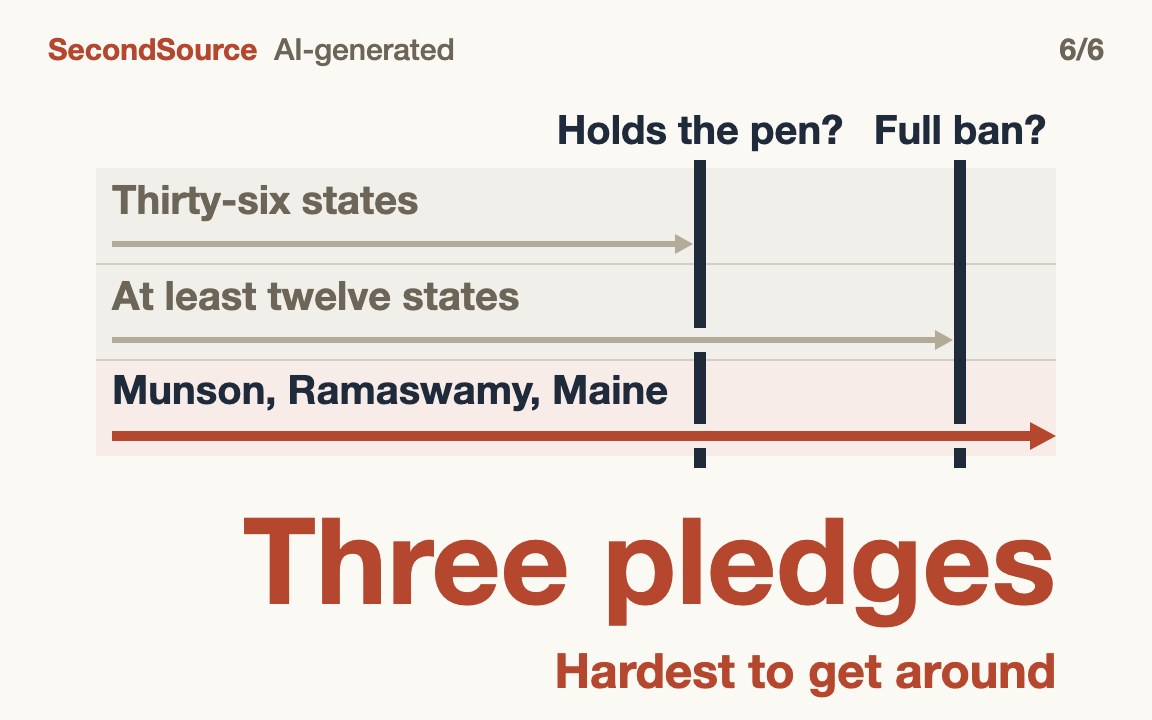
Counting states where candidates mention data centers no longer tells anything. The 36 states whose races debate the topic do not show which pen-holder pledged to sign; the 12 or more states with a pro-pause candidate do not show whether it is a blanket ban. Ask each candidate two questions:
- Does the office hold the pen? (section three) That decides whether the pledge becomes policy.
- What is being asked for? (section five) A blanket ban, or self-supplied power and full payment? That decides whether on-site generation still works.
Yes to the first and "blanket ban" to the second means a candidate for governor pledged to enact a blanket pause once elected. Such candidates are a minority, yet they are the new risk developers will find hardest to get around. This piece found three (as of September 19; not a complete list): Oklahoma's Munson (section three), the most specific; Ohio's Republican candidate for governor, Ramaswamy, demands legislation with a statewide pause until it passes; and the candidates from both parties in Maine (section three). In the coverage read here, all three would pause all new building with no exemption mentioned, so they count as yes to both; whether the original texts exempt on-site generation stays unchecked until after the November 3 count.
Our call
Developers' timelines move from the permit-by-permit schedule to the election calendar; also watch how many states write self-supplied power into rules.
What this changes, and for whom
- Developers and site-selection teams: check new sites for the first half of 2027 against the governors elected in November who pledged to sign a pause; off the list the question is mostly cost, on the list whether the project can be built.
- Generation equipment suppliers and gas-power investors: our read is that while blanket bans stay in a minority of states, this election favors on-site generation; if a state starts rejecting on-site gas projects in bulk on air permits, that reading comes down.
- Lenders and infrastructure funds: where the governor changes, inauguration day is known, and whether the new governor's first executive order covers the project can become a condition for drawdown.
What would prove this wrong
Deadline, set by this publication: June 30, 2027, covering the first legislative session under the new governors.
1. A state passes a statewide ban by legislation, with no exemption for on-site generation. Section four (still an executive order) and section five (a cost for on-site developers) fail together.
2. Any federal data-center moratorium bill reaches a committee vote. Section three's reading of the federal bill is withdrawn.
3. Every candidate for governor who pledged a pause loses in November, and no new governor signs a pause in the first half of 2027. This piece overestimated the risk the election added.
4. A governor elected on a pause pledge withdraws that pause within the first year. Section four's "revoking gets more expensive" fails.
5. On-site generation projects in any state get blocked in bulk because of a campaign pledge rather than air permits. Section five has to be rewritten.
Appendix: how the numbers were obtained
Timeline
| Date | Event | Level |
|---|---|---|
| March 25 | Senator Sanders and Representative Ocasio-Cortez announce an AI data-center moratorium bill; Sanders says a moratorium is needed at the federal level | Federal bill |
| June 24 | The House version is formally introduced, with nine cosponsors, all Democrats | Federal bill |
| July 14 | New York's governor reportedly signs a pause | Governor's executive order |
| July 21 | Newsweek: candidates for governor in at least 12 states support an AI data-center pause | Governors' races |
| August 3 | Texas's governor reportedly orders an audit of the data centers waiting to connect to the grid | Governor's executive order |
| August 8 | Michigan's Democratic Senate candidate El-Sayed says no further data center should be approved until federal guardrails exist; Ohio's Republican candidate for governor, Ramaswamy, publishes a pledge demanding legislation, with a statewide pause until it passes | Senate and governors' races |
| August 18 | Pennsylvania's governor signs an executive order: state permits require local approval first, and developers must follow the governor's grid standard (GRID); no pause is issued (WHYY); the same week the NRSC circulates an internal memo calling data centers a sleeper issue for the midterms | Governor's executive order; party machine |
| August 20 | Rogers switches to backing a Michigan pause | Senate race; state-level policy |
The unpublished September 11 internal call, line by line
- "August 20 is the first time the resistance took the form of a federal campaign pledge": does not hold. Rogers wanted a state-level pause and said he does not support a federal ban; the federal bill dates from March, and candidates for governor in at least 12 states supported a pause by July. Narrowed to section two's "first Republican Senate candidate in a swing state to switch to supporting a pause".
- "A pledge runs for a term and under public scrutiny, so it is harder to revoke than an administrative action": holds only for officials who hold the pen once elected; see sections three and four.
- "Both of the developers' tools fail at once": case-by-case negotiation is getting harder; on-site generation becomes more valuable under most campaign rules; see section five.
- "The leading indicator is how many states have a candidate who put data centers in the platform": replaced by the two questions in section seven.
- The mechanism the call assumed was that public opinion turns into platform pledges. The opinion half holds; the ballot-payoff half has mixed evidence; see section six.
The federal bill and Congress
- The text of the House version says that construction or expansion of an AI data center may not begin or continue until Congress passes a set of laws, including federal review and approval of AI products before market. Enforcement goes to the Secretary of Energy, who may tie compliance to future permits.
- The bill defines a data center by capacity: anything above 20 megawatts that meets a high-density or liquid-cooling condition, with no exemption for on-site power.
- As of September 19, govinfo (the US government site that publishes bill texts) and the senator's press releases showed no committee vote; some pages on the congressional website could not be loaded at the time.
- Side evidence: according to syndicated reporting, House Speaker Johnson called a federal ban a dangerous idea a few days before September 19. Miles Brundage, formerly head of policy research at OpenAI, wrote on X on August 23 that a national data-center moratorium is a bad idea and that he does not think one will happen.
Other revocations and pauses
- After lifting its pause on June 12, Hill County switched to a checklist requiring applicants to disclose information.
- Imperial County, California, reportedly had a pause stayed by a court order.
- New Hampshire's sitting governor has reportedly said a multi-year pause will go into the budget, taking effect in July 2027 at the earliest; only the headline and summary were seen.
- SemiAnalysis documented a project that escaped Brownsville's city pause by having the land taken outside the city limits, where the city's pause no longer applies.
Other on-site generation readings
- Florida's Republican candidate for governor, Donalds, reportedly wants data centers barred from public power and water and has not called for a pause, another case of turning opposition into a cost.
- SemiAnalysis forecast in June that from 2028 on-site generation would supply more than half of new US data-center capacity.
- One reported case of the local fight over gas generators: Musk's second supercomputer in Mississippi installed dozens of gas turbines without the required permits.
- The Abbott guardrails also say data centers must bring electricity prices down; this piece did not find what that requires of developers.
- Munson's line that Oklahoma's water and power belong to Oklahomans also points at a blanket pause.
Polls and the campaign
- Gallup, March: 71 percent of Americans opposed an AI data center near home. A separate May poll with a sample of more than 4,000 reportedly found 75 percent opposed; the polling organization was not identified.
- The NRSC memo also says that if the Ohio Senate race is lost over data centers, the industry will be blamed, and both parties will take note.
- An investigative outlet reported that Rogers changed position days after the outlet disclosed AI-related holdings in the candidate's portfolio. Only a summary of that report was read, and this piece does not use the report to explain the switch.
- The four reasons Rogers listed: community control, electricity bills, water, and stopping pay-to-play schemes.
Measurement notes
- Rogers's remarks come from the Detroit News, whose original is paywalled. The text read for this piece is the same article as syndicated on Yahoo, checked line by line against the same-day report by E&E News, a trade outlet covering energy and environment policy. In E&E News's account, Rogers supports a one-year Michigan pause approved by state decision-makers, not a national ban.
- Pledge fulfillment: a 2017 cross-national study in the American Journal of Political Science by Thomson, Royed, Naurin and colleagues reports in the abstract that in the United States more than 60 percent of the pledges made by the president's party are at least partly fulfilled, and that the side without executive power fulfills markedly fewer. The study looks at governing parties at the national level, and "at least partly fulfilled" is a low bar. Only the abstract was read; applying the result to candidates for governor and senator is this piece's analogy.
- MultiState's "most candidates" is a qualitative reading with no candidate-by-candidate count. The figure of 36 is the number of states where candidates for governor are debating data-center policy; "at least 12 states" counts states with a candidate for governor who supports a pause. The two cannot be subtracted.
- "The developers who can pay that cost are the ones generating on site" is a directional call; this piece has no cost comparison between on-site generation and paying for grid expansion.
- Mace's loss comes from E&E News; Hong's loss, by under a percentage point in the Democratic primary, was seen only in several outlets' headlines; the Michigan count of 14 was read only in summary.
The trend line this publication tracks
This publication maps which level of government ends up carrying data-center resistance. The four routes differ in how easily each can be undone. So far only local permits and governors' executive orders have actually been used.
Open ?
Where this piece sits: the evidence here lands on the governor's executive order. The election hands the pen to governors, and what gets delivered is still a revocable order. Which route wins is open until the new governors' first orders and the first legislative sessions in the first half of 2027.
Sources
Original documents and reports read directly for this piece; items seen only through syndication, headlines or summaries are marked in the body and appendix.
- E&E News · 2026-08-20: Republican Mike Rogers backs Michigan data center moratorium
- The Detroit News · 2026-08-20 (read via Yahoo syndication): detroitnews.com
- X / @CraigDMauger · 2026-08-20: x.com/CraigDMauger/status/2090507867031851158
- Senator Bernie Sanders press release · 2026-03-25: sanders.senate.gov
- govinfo · H.R. 9442 bill text: govinfo.gov
- Newsweek · 2026-07-21: newsweek.com
- NPR · 2026-08-08: npr.org
- WHYY · 2026-08-18: Pennsylvania Gov. Shapiro signs wide-ranging executive order reining in data center development
- MultiState · 2026-09-01: Gubernatorial candidates are speaking out on data centers
- SemiAnalysis · 2026-09-15: Everyone Says Datacenter Moratoriums Are Killing the US Buildout. We disagree
- X / @Miles_Brundage · 2026-08-23: x.com/Miles_Brundage/status/2091616389140512934
Written from the same research and judgments as the Traditional Chinese edition. Sources are linked; we distinguish original documents from reporting and mark what we could not verify.